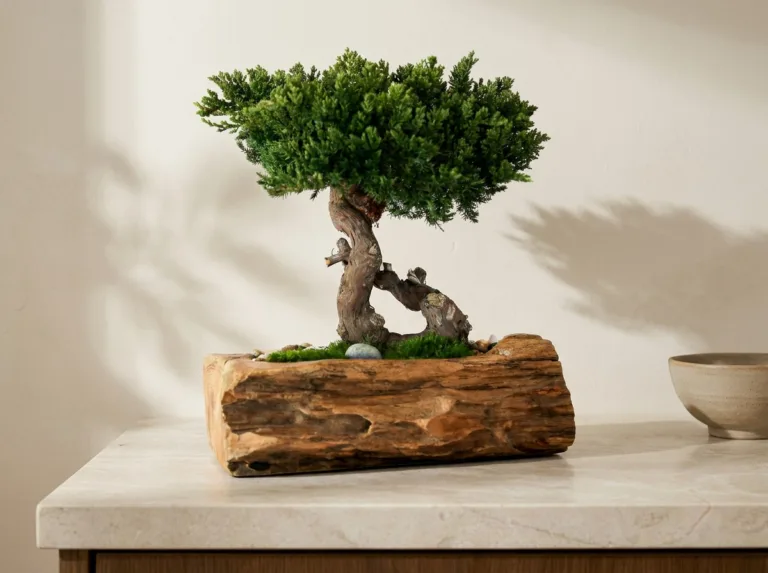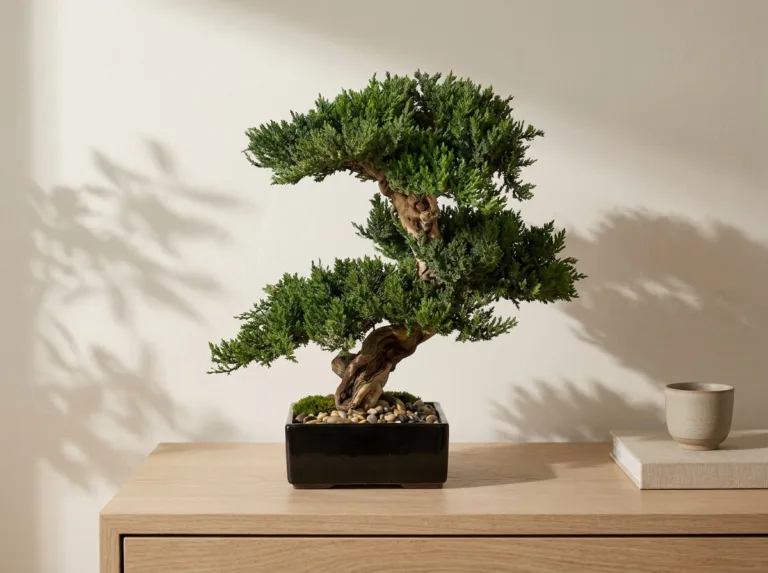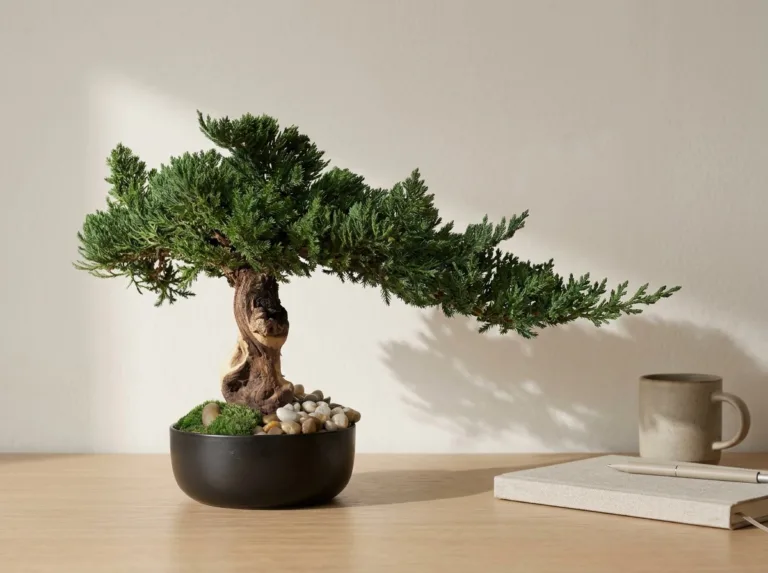
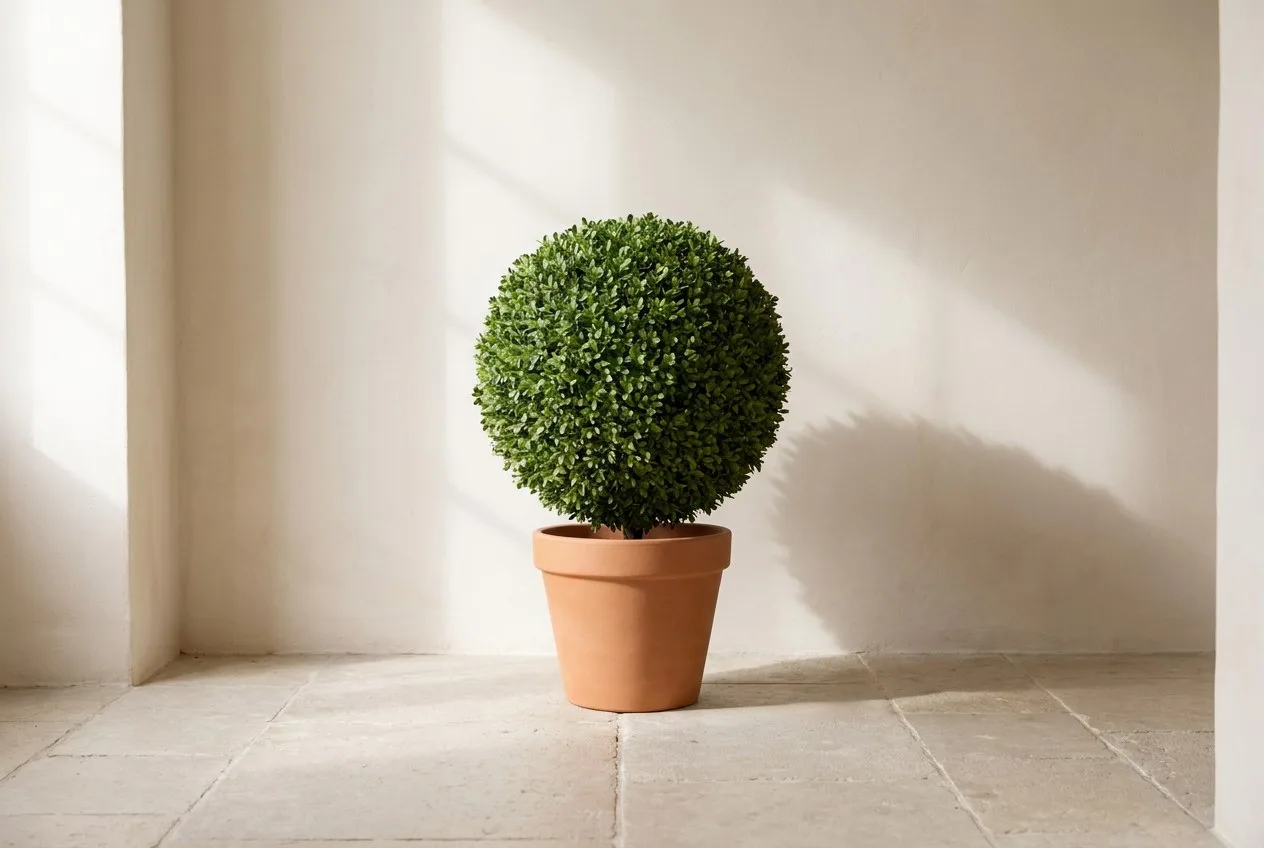
A preserved spiral is usually the right buy for an interior, because you never have to cut it again. Both kinds are years of cutting held in a plant. The live one keeps growing, so somebody has to keep cutting it; the preserved one has stopped.
Preserved foliage on a steel armature. It holds the shape it arrived in, which is why it suits an interior and why it cannot go outside.
What you are buying
You are buying real foliage. It was grown and shaped as a live plant, then treated so it holds that state without water. The moisture is replaced with a glycerin solution over roughly a fortnight, and the glycerin sets inside the leaf so the texture stays soft. The method is published in full.
Ask what is inside before you buy anything over about three feet. A welded steel armature keeps a tall shape upright. On an 84-inch spiral it supports the entire shape; something lighter will lose its shape long before the foliage wears out. On a ball the frame does little.
Price, against the live equivalent
Ours run from about $450 for a 40-inch preserved juniper cone to $998 for a 60-inch preserved arborvitae. The 84-inch juniper spiral is quoted individually.
Purchase price rarely decides it, because preserved and live sit in the same broad bracket. Our live boxwood spirals start around $895 at 30 to 36 inches. Those are different shapes at different heights, so it is not a like-for-like comparison and we will not pretend it is.
Running cost decides it. A live spiral needs two cuts a year for its whole life, by somebody who can cut a spiral without flattening it. A preserved one needs dusting. Over five years in a commercial interior, you pay for that skilled cutting again and again.
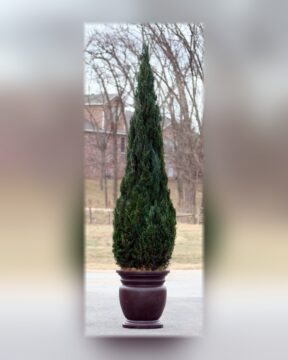
$450. A preserved juniper cone, from 40 in.
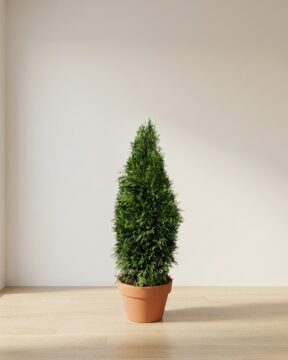
$998. Preserved arborvitae at 60 in.
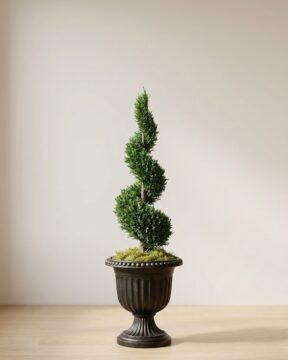
Quoted. An 84 in juniper spiral, quoted with freight.
When live is still right
Outdoors, live wins every time. A preserved piece has no roots and no water uptake, so weather has nothing to work with, and it will not recover from a season outside.
Live is the better buy indoors too, if the room has real daylight and somebody enjoys the work. A live plant thickens and improves as it grows. A preserved one holds still.
Choose a live plant for a bright atrium. Sun fades preserved foliage permanently.
When preserved wins
Preserved wins wherever there is no daylight, which is most corridors, lift lobbies and inner meeting rooms. It wins again in buildings where nobody is responsible for plants, and in fit-outs where the piece has to look identical on day one and on day one thousand.
Boxwood lasts around seven years, juniper seven or more, indoors and out of sun and damp. Those figures come from the preservation records for the lines we carry.
Direct sun fades it unevenly, and permanently. Real damp softens it, so a pool surround or an unventilated wet room is the wrong home.
Specifying one
Start with the plinth. Standing a three-foot piece up on a plinth changes how it reads more than any other decision you make, so settle that before you fix the height and the container.
These carry no fire rating. Where a scheme requires a rated interior finish, the usual route is an artificial piece with a fire-retardant treatment, special-ordered. Raise it early rather than at delivery.
Anything over about four feet travels by freight and is quoted with its delivery. The whole range is on the preserved spiral and cone category. For the wider interior case, read preserved topiary for interiors, and for the live side of it, why a boxwood spiral costs what it does.
Questions we get asked
Is a preserved spiral cheaper than a live one?
They are close at comparable heights. Ours run from about $450 for a 40-inch cone, and live boxwood spirals start around $895 at 30 to 36 inches. The live one then needs cutting twice a year for its whole life, which is where the money goes.
Can a preserved spiral go outside?
No. It has no roots and no water uptake, so weather has nothing to work with, and it does not recover from a season outside.
How long does it last?
Boxwood around seven years and juniper seven or more, kept indoors and out of sun and damp. Those figures come from the preservation records for the lines we carry.
What is inside a tall one?
A welded steel armature. On anything over about three feet it holds the line of the shape, and a piece built on something lighter loses its form long before the foliage tires.
Is it fire rated?
No. Where a scheme requires a rated interior finish, the usual route is an artificial piece with a fire-retardant treatment, special-ordered. Raise it early.