













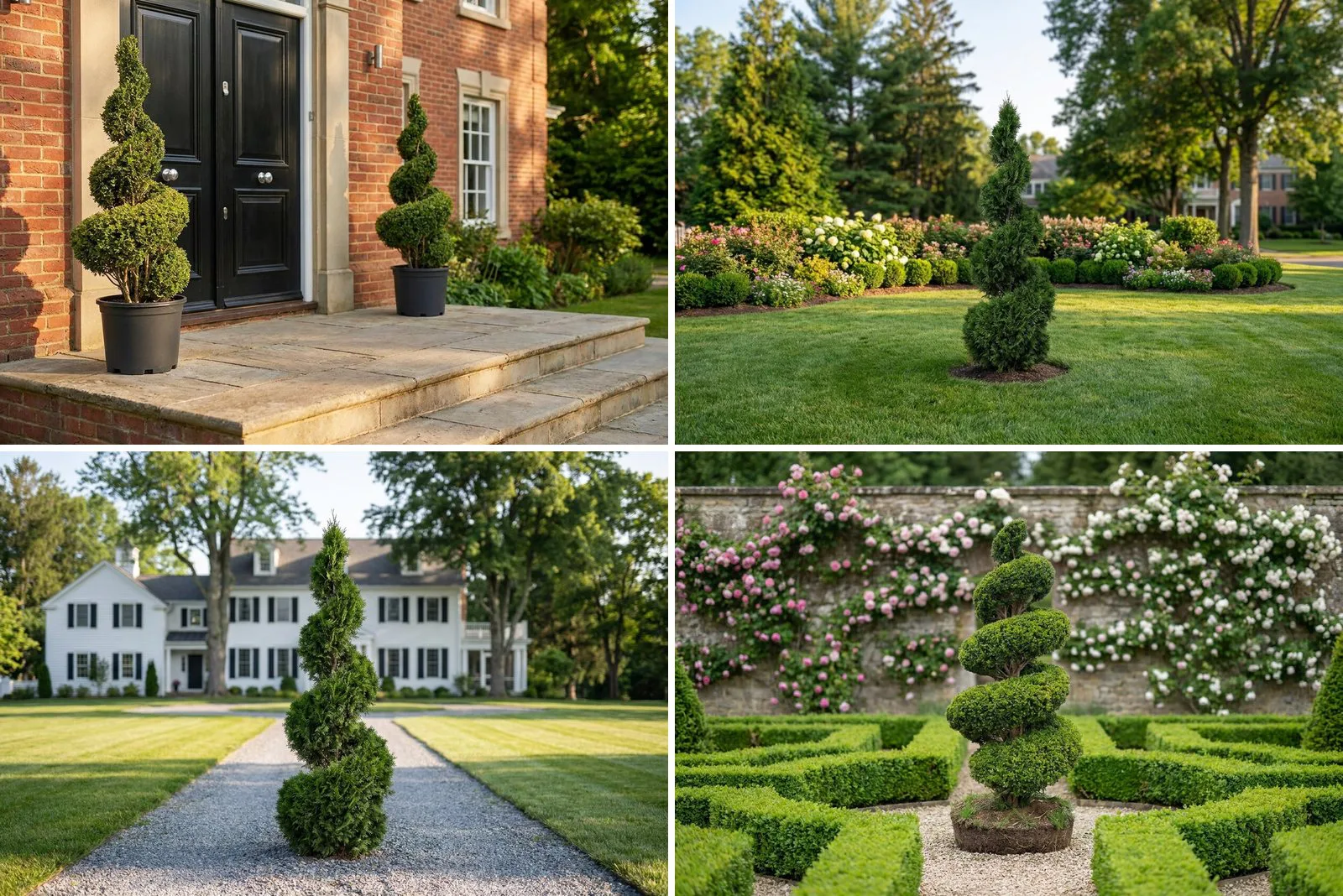
A boxwood spiral costs more than a ball or a cone of the same height because it takes years to make. The spiral is cut into a growing plant, and the plant then has to fill out along that line, a little each season. Ours start at $895 for a 30 to 36 inch spiral and run to $5,500 for a nine-foot one.
Price climbs faster than height on this shape. Here is why, and how to keep the spiral you pay for.
How a spiral is made
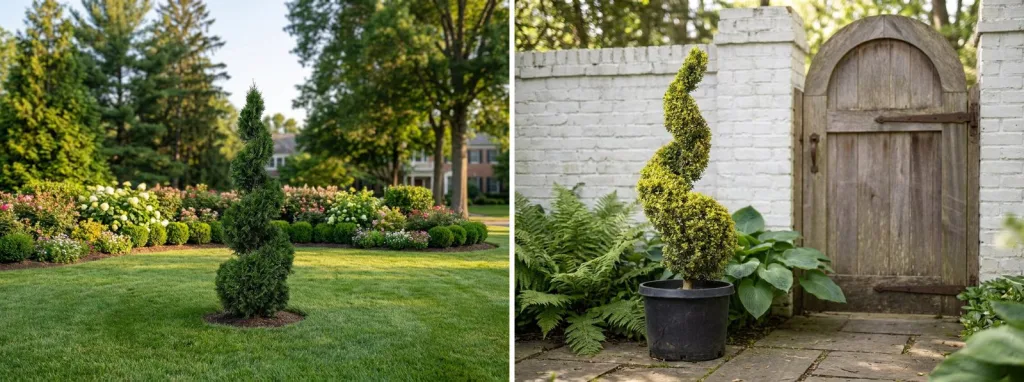
A spiral starts as a cone. The plant is grown dense enough to cut into, one stem is chosen as the leader, and the spiral is cut around it in a continuous band. In the gaps the foliage goes back to the stem. On the ridge it stays full.
The first cut sets the line. Every cut after that deepens the gap and thickens the ridge. The shape only reads properly once the ridge has grown dense enough to hold a clean edge, and that takes years.
So a spiral and a ball of the same height are not comparable prices. The ball is one continuous surface. Each cut on a spiral must follow the line that is already there.
What the sizes cost
| Live spiral | Price |
|---|---|
| Boxwood, 30 to 36 in | $895 |
| Boxwood, thick spiral, 58 to 61 in | $1,295 |
| Green Beauty boxwood, 9 ft | $5,500 |
| Other boxwood sizes, 24 in to 9 ft | Quoted |
| Arborvitae, 17 ft | Quoted |
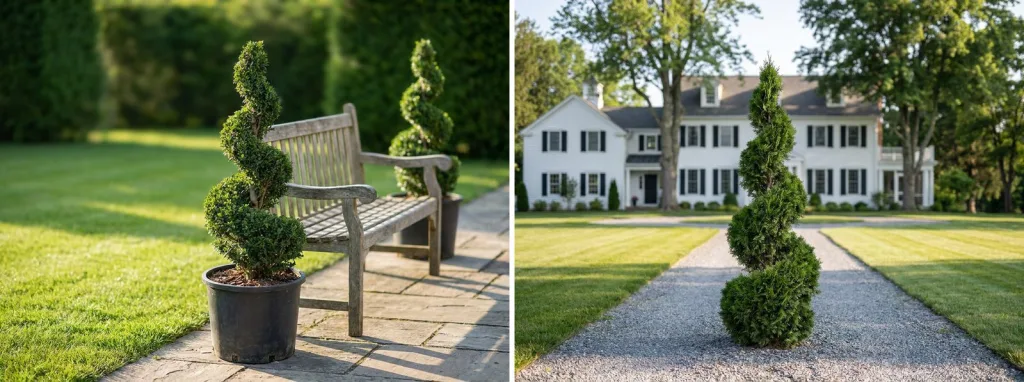
Price climbs faster than height, for two reasons. A taller spiral has more turns, and every turn is more cutting. A taller spiral has also spent more years growing before it is ready to sell.
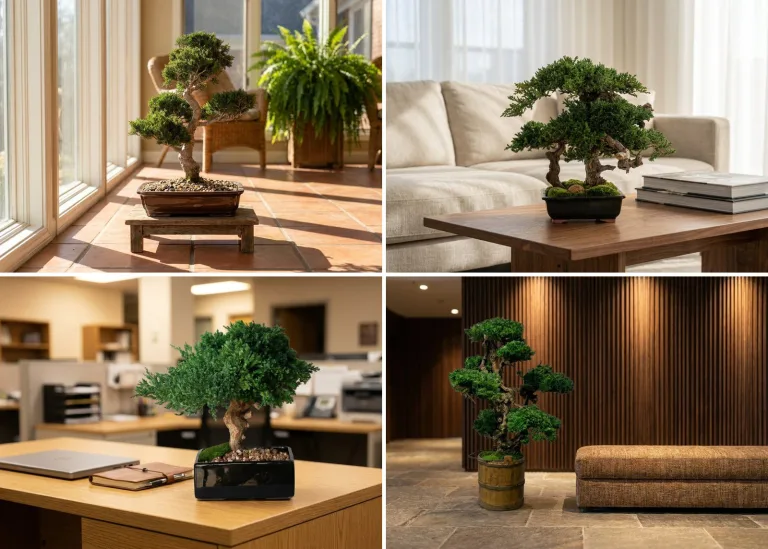
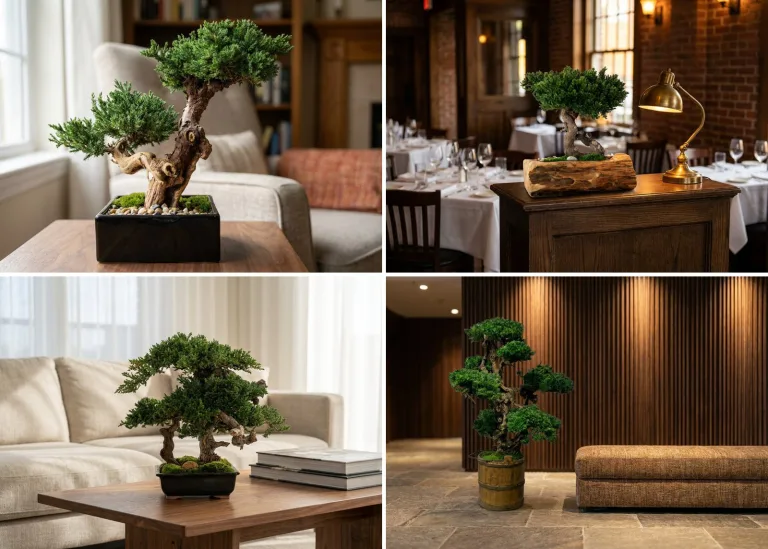
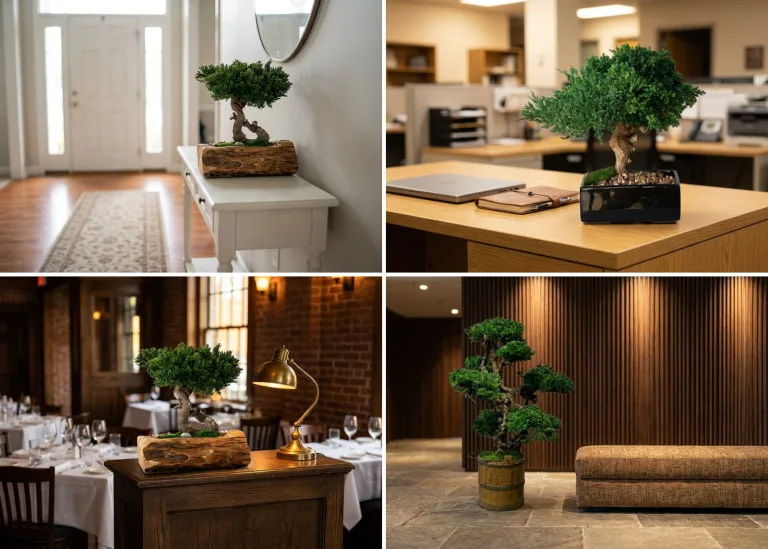
Preserved spirals are a different purchase at a different price, because the hand work is done once and then held. We carry them up to 84 inches in juniper, and they live indoors only. Preserved topiary for interiors covers where they work.
Cutting one: follow the line you already have
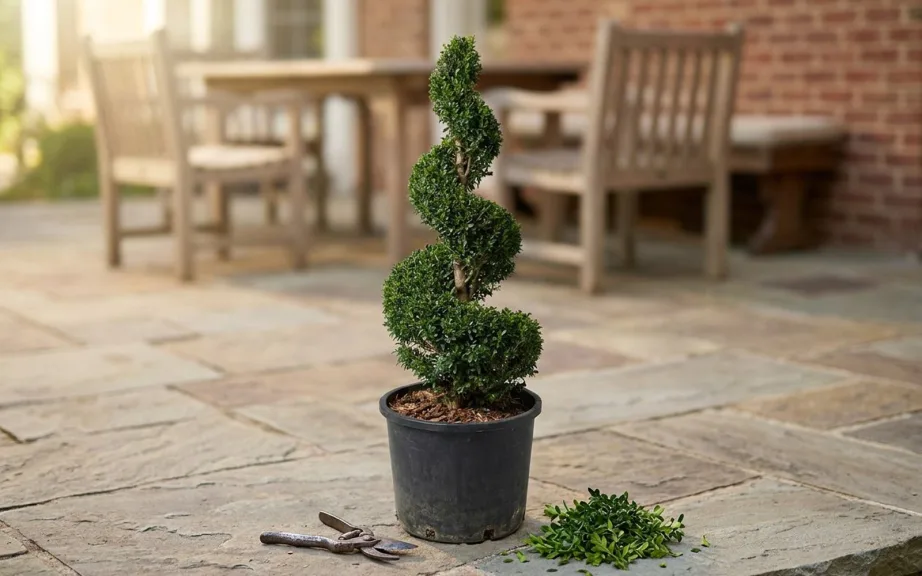
Cut twice a year, the same as any boxwood: the main cut in early June once the spring growth has firmed, and a light tidy in late summer, finished by early September.
On a ball you cut to a surface, so a small error blends in. On a spiral you cut to an edge, so the error stays. Take the gap back to the same depth each time and follow the existing line rather than improving it.
Do not tidy the ridge narrower. A ridge only gets thinner.
Cut the gap first, with hand shears, then dress the ridge. Cutting both in one pass with hedge shears flattens the spiral. It takes longer, and it is the difference between a spiral at year five and a lumpy cone.
The timing and feeding rules in what a live boxwood costs to keep apply here unchanged.
Where to put one: against something plain
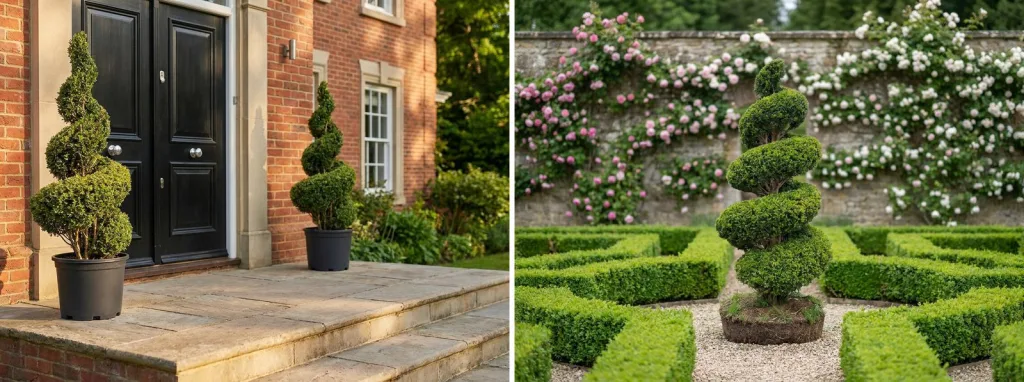
A spiral is a vertical accent, so put it where the line can be seen. Against a busy border it disappears. Against a wall, a hedge face or a doorway it does what it is for.
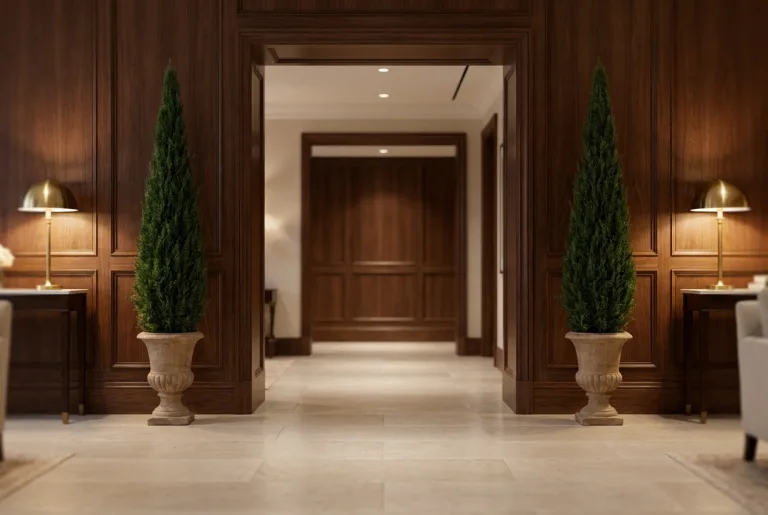
Order entrance spirals together so they are selected as a pair. They are almost always bought in pairs for a doorway, and two spirals cut by different hands in different years will not match.
In a container, read the zone tables one step conservatively. A root ball above ground behaves roughly like one zone colder than the same plant in the earth. Boxwood in a planter sets out what that means in practice.
When a live spiral is the wrong choice
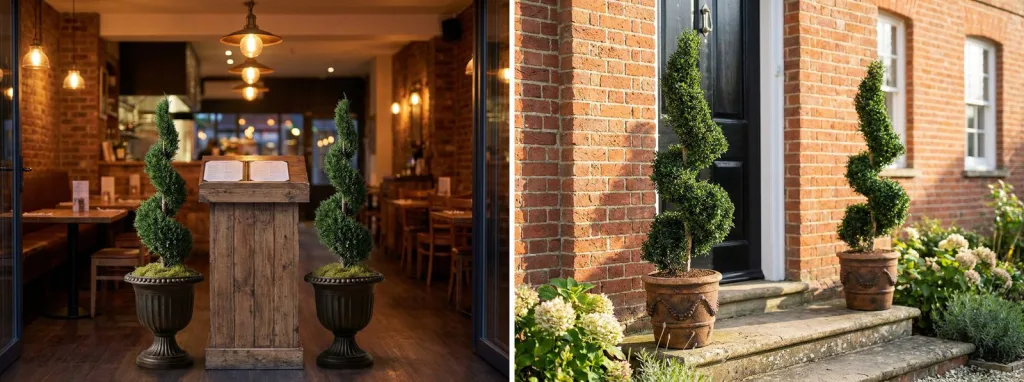
The live range is in the spiral category. If the position cannot keep a plant alive, the artificial spirals hold the same silhouette with no cutting at all, from 3 to 10 feet.
Quick answers
Why are spiral topiaries more expensive than balls?
Because the shape has to be grown into over years. A ball is cut to one surface. A spiral is a line cut a little at a time, and a taller one has more turns and more seasons behind it.
How much does a boxwood spiral cost?
Ours start at $895 for 30 to 36 inches. A thick 58 to 61 inch spiral is $1,295, and a nine-foot Green Beauty spiral is $5,500. Other sizes are quoted.
How do I cut one without losing the shape?
Cut the gap first with hand shears, then dress the ridge. Cutting both in one pass with hedge shears is what flattens a spiral into a lumpy cone.
Can I buy a matched pair?
Yes. Order them together so they are selected as a pair. Two spirals cut by different hands in different years will not match, and a spiral is the shape where that shows most.
Is a preserved spiral the same thing?
It is the same shape, cut once and then held. The foliage is real, treated to last without water. It goes indoors only, and it needs no cutting at all.