

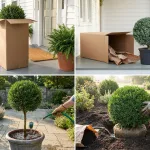

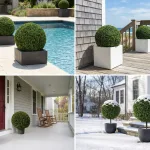

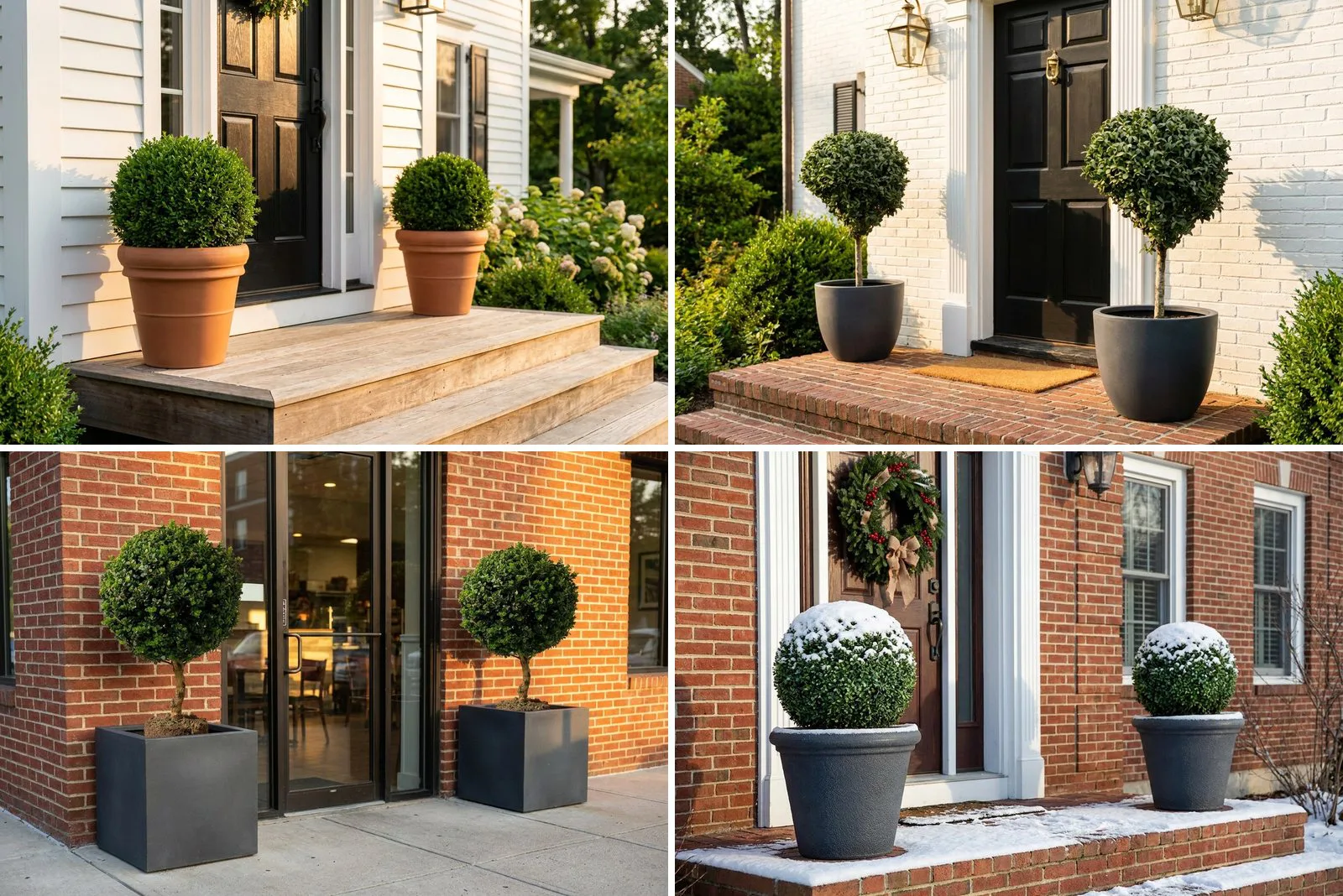
Boxwood grows well in a planter if you choose a slow cultivar, a planter wide enough for its root ball, and water it more often than you would in the ground. Pick a cultivar hardy to one zone colder than yours, because roots in a pot get colder in winter.
Most potted boxwood that dies is killed by dry roots or standing water, and cold is rarely the cause.
Can boxwood grow in a pot?
Yes, and it is one of the few evergreens that suits a pot for years. Boxwood roots are fine and shallow, closer to a mat than a taproot, so a wide container suits it better than a deep one. What boxwood will not tolerate is sitting in water, drying out completely, or a fast cultivar outgrowing a pot that cannot hold it.
The difference between a container boxwood that looks better every year and one that browns from the inside is usually decided before planting: which cultivar, and how big a planter.
Which boxwood suits a container
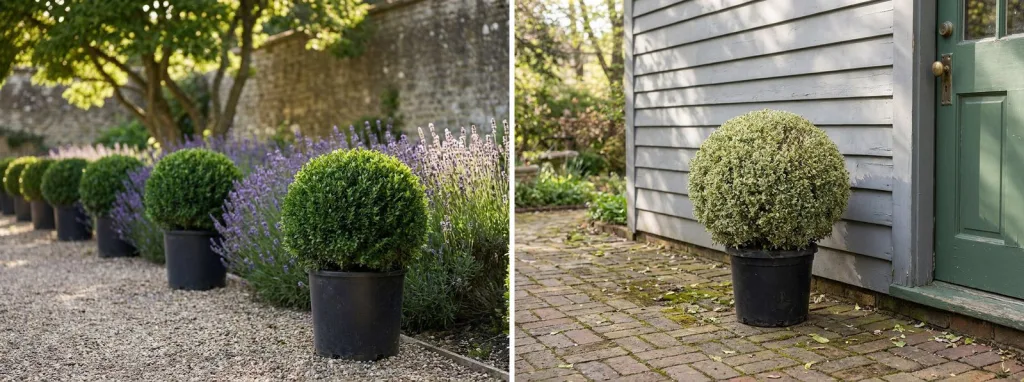
The number that matters is the growth rate, because a container is a fixed size and the plant is not. These are typical published rates for common cultivars.
| Cultivar | Growth a year | In a container |
|---|---|---|
| ‘Green Pillow’, ‘Morris Dwarf’ | 0.5 to 1 in | Ideal. Decades in the same planter. |
| ‘Grace Hendrick Phillips’ | 0.75 to 1.5 in | Very good. Spreads more than it climbs. |
| ‘Green Beauty’ | 1 to 2 in | Very good, and it keeps its color in heat. |
| ‘Vardar Valley’ | 1 to 3 in | Good, and very hardy. |
| ‘Green Velvet’, ‘Green Gem’ | 2 to 3 in | Good. Expect to repot eventually. |
| ‘Rotundifolia’ | 3 to 6 in | Outgrows a container quickly. |
| ‘Winter Gem’ | 4 to 6 in | Outgrows a container quickly. |
Read that as years of comfort. A slow cultivar at half an inch to an inch a year will sit happily in a 30 inch planter for the better part of two decades. A fast one at four to six inches a year soon fills the pot with roots, dries out in a day and needs a bigger container or a hard root prune.
So for a planter you want to leave alone, choose slow. For a piece you want at full size quickly, a fast cultivar is a fair trade, as long as you plan to repot. We carry ‘Green Beauty’, ‘Rotundifolia’ and ‘Winter Gem’ in the live boxwood range.
One caution about hardiness. Zone ratings are written for plants in the ground. A root ball in a container is exposed on all sides and gets about one zone colder, so for a pot, choose a cultivar rated for one zone colder than yours. The boxwood zone guide lists the ratings.
How big does the planter have to be?
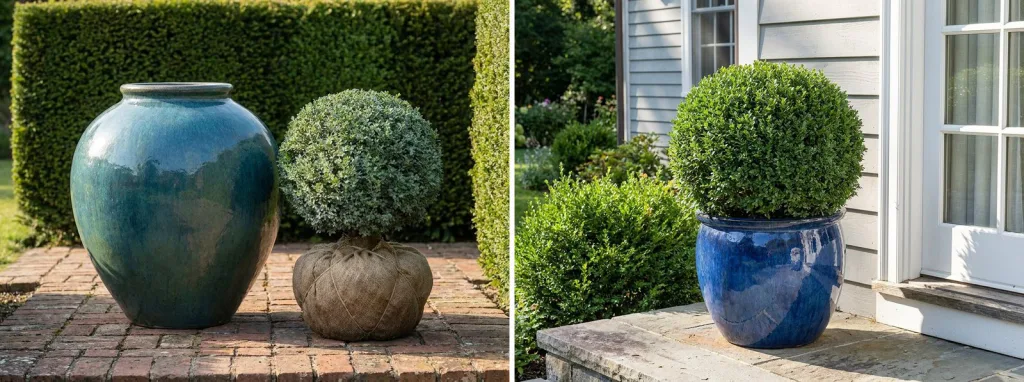
Bigger than most people buy. Two numbers decide it, and only one is about looks.
The first is the root ball. A mature live boxwood usually arrives on a 24 inch root ball, and that ball has to pass through the opening of the planter.
Many large planters narrow sharply at the mouth. One jar in our range measures 39.5 inches across its belly and has an opening of 21 inches, too small for a 24 inch ball.
The second is balance. A planted piece looks settled when the plant stands about one and a half times the height of the container. Much taller than that, it looks top-heavy and catches the wind.
Both are worked through, with the measurements, in what size planter a topiary needs.
Watering, which is what actually kills them
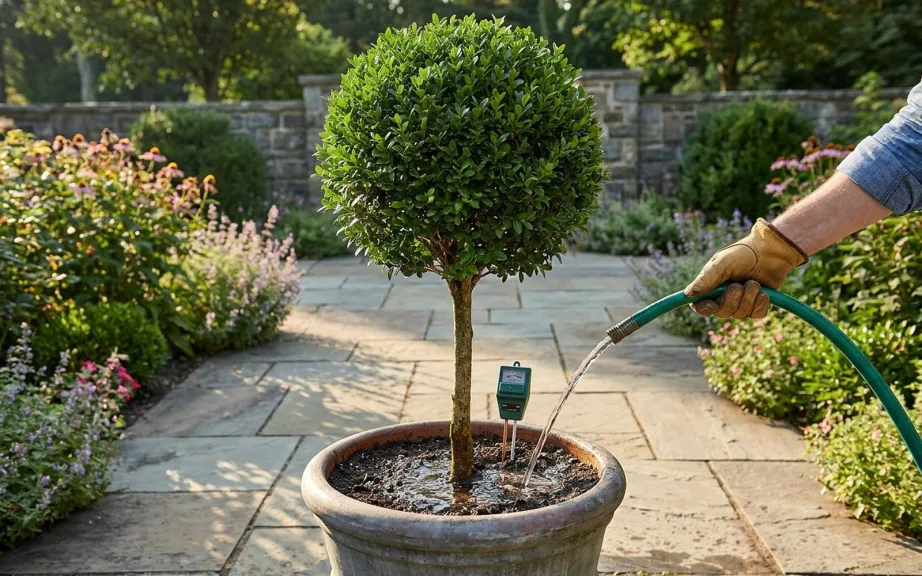
Boxwood in the ground is drought-tolerant once established. Boxwood in a pot is not. Its fine roots grow out of the ball they arrived on slowly, and until they spread into the new mix, the plant drinks from a much smaller volume of soil than the pot holds.
Water the root ball itself. In the first season, soak it deeply and check it with a finger instead of trusting a schedule, because the mix around it can be damp while the center is bone dry. That failure looks exactly like disease: dull leaves, then bronzing, then whole branches browning from the inside.
In summer, check pots every day or two.
The other half is drainage. A pot with no way out holds water at the bottom, and boxwood roots in standing water rot. If a planter has no hole, drill one or plant into a liner that lifts out. Never plant straight into a sealed container.
Our team can check the drainage on any planter in our range before you order.
Feeding a boxwood in a container
A boxwood in the ground is fed twice a year with a balanced 10-10-10 or 14-14-14, in early March and again in October. In a pot, feed washes out with every watering, so feed more often and more lightly: a liquid feed at half strength through the growing season works better than two heavy doses.
Avoid high-nitrogen feeds. Soft, fast growth on a boxwood holds its shape badly and burns in a cold wind.
Winter in a container
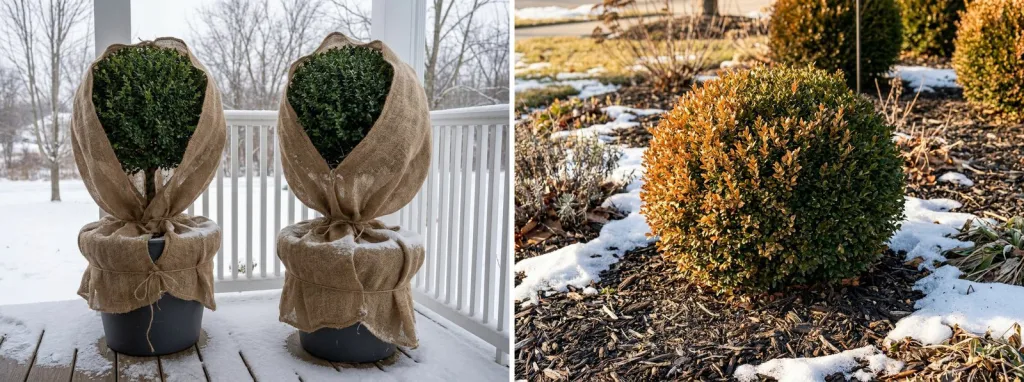
The boxwood most likely to suffer in winter is the one that went into December in a dry pot.
An evergreen keeps losing water through its leaves all winter. When the root ball is frozen or dry, it cannot replace that water, and the plant dries out. The damage shows in February and March as bronzing, and people blame the cold when the real cause was a dry pot in November.
The winter routine is short. Water containers deeply until the ground freezes. Move the planter out of the worst of the wind, because wind dries the leaves faster than cold does.
Where winters are severe, group pots together, wrap the pot in burlap or bubble wrap, or move it into an unheated garage for the hardest freezes. It is the root ball you are protecting.
Do not wrap the foliage in plastic, which cooks the plant on the first sunny day. And do not worry about bronzing on the side that faces the winter sun. It greens up when new growth comes in spring.
Pruning, and holding the shape
Container boxwood follows the same calendar as boxwood in the ground: the main cut in early June, so new growth covers the cut edges by mid-August, and a light tidy in late summer, finished by early September. Do not cut in winter, and leave freeze-burned tips until the last frost has passed, because the damaged growth protects the leaves behind it.
A potted boxwood that holds its shape and puts on little size is not in trouble. That is what a slow cultivar in a well-chosen pot should look like.
What we sell, and how it arrives
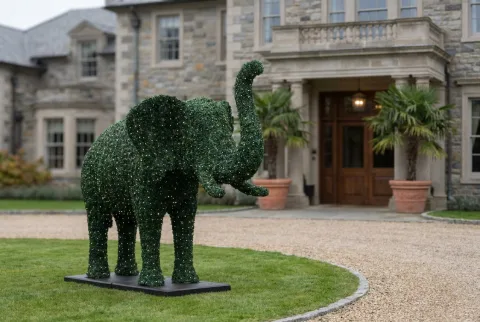
We sell live boxwood as balls, cones, spirals, standards on a stem and tiered pieces, in the sizes listed on the live boxwood topiary pages. Pieces up to about 45 inches ship by parcel. Larger ones travel by freight, most on a 24 inch root ball.
The planters are bought in from specialist makers and sold separately on the planters pages. For a boxwood, the wide, straight-sided pieces suit best. If you are matching a plant to a planter, tell us both and our team will confirm the opening before you order.
Quick answers
How often should I water a boxwood in a pot?
Check it every day or two in summer and water when the top inch is dry. Water slowly until it drains from the bottom. In spring and fall, once or twice a week is usually enough.
What zone should a potted boxwood be rated for?
One zone colder than yours. Roots in a pot get about one zone colder in winter than roots in the ground.
Can a potted boxwood stay outside in winter?
Yes, if it is rated one zone colder than yours and goes into winter well watered. In exposed spots, wrap the pot or move it out of the wind.
What is the best boxwood for a planter?
A slow grower such as ‘Morris Dwarf’, ‘Green Pillow’ or ‘Green Beauty’. They stay in proportion to the pot for many years.