A preserved bonsai is a real tree that has stopped needing anything. The foliage grew, was cut, and had its own moisture swapped for glycerin over about a fortnight. The trunk is natural wood. You get seven years or more with no water, no light and no shears. The tree will never grow again and cannot be brought back.
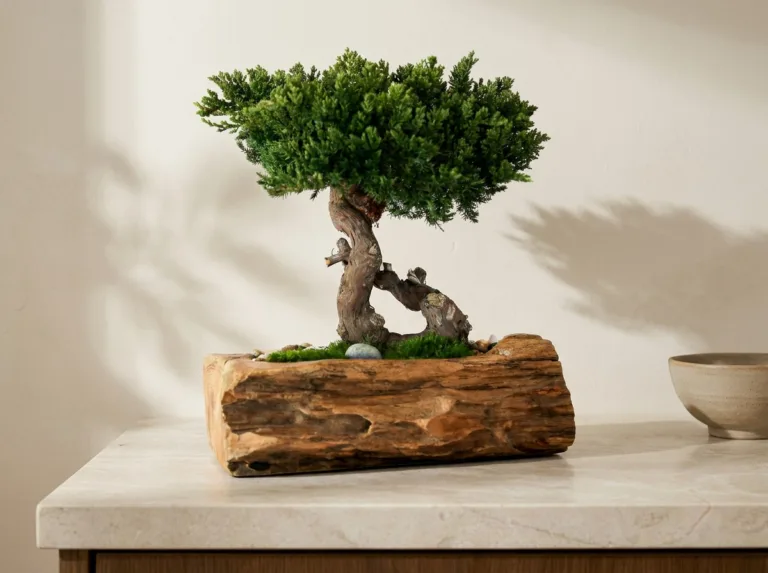
A sixteen-inch piece from the range we carry, standing on a console.
What preserved actually means
The leaves are real. They grew on a juniper, they were cut, and they were treated so they stay as they were. A preserved piece survives being looked at closely, which is the test a bonsai gets and a hedge does not.
Three different things get sold as bonsai, so the word on the label is doing a lot of work.
A live bonsai is a plant. It photosynthesises, it needs water on a schedule and light from the right direction, and it needs wiring and pruning to stay in proportion.
An artificial one is polyester and moulded plastic on a wire armature, made in a factory. Nothing in it ever grew.
A preserved one is the real plant, cut at its best and treated to keep that shape. It sits between the other two, much closer to the live one than most people expect.
It is no longer a plant, so it has no hardiness zone, no watering schedule and no growing season. Much of the confusion around preserved material comes from people looking for them anyway.
How the preserving is done
The bonsai we sell are bought in, so read this section as how preserved foliage is made rather than as a claim about who made these. The method is set out in full on our preservation page.
Plants are grown and shaped first, because only material that reaches its final form cleanly is worth the trouble.
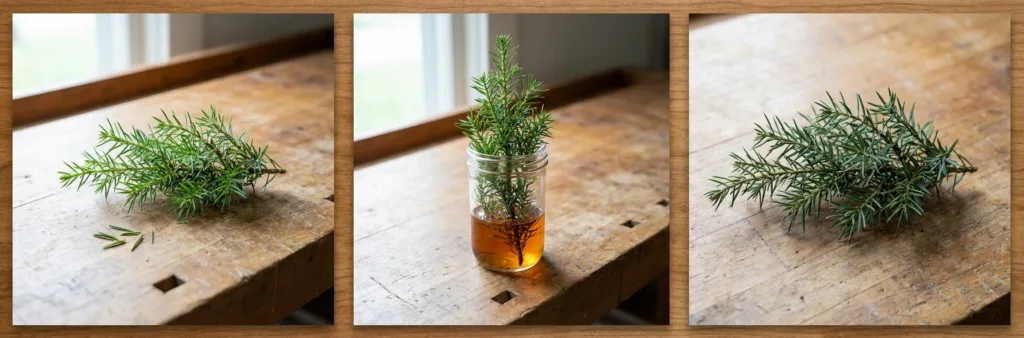
The preservation itself takes 10 to 14 days. Foliage goes into a room held at controlled heat and low humidity, which pulls its own moisture out. As it loses that moisture it draws up a food-grade glycerin solution in its place.
The glycerin then sets inside the leaf and the stem. That is what keeps the texture soft and stops the foliage drying to the point where it shatters at a touch.
Colour comes from FDA-approved food-grade dye added during the soak, usually to hold the plant’s own green. A hand trim at the end captures the finished shape.
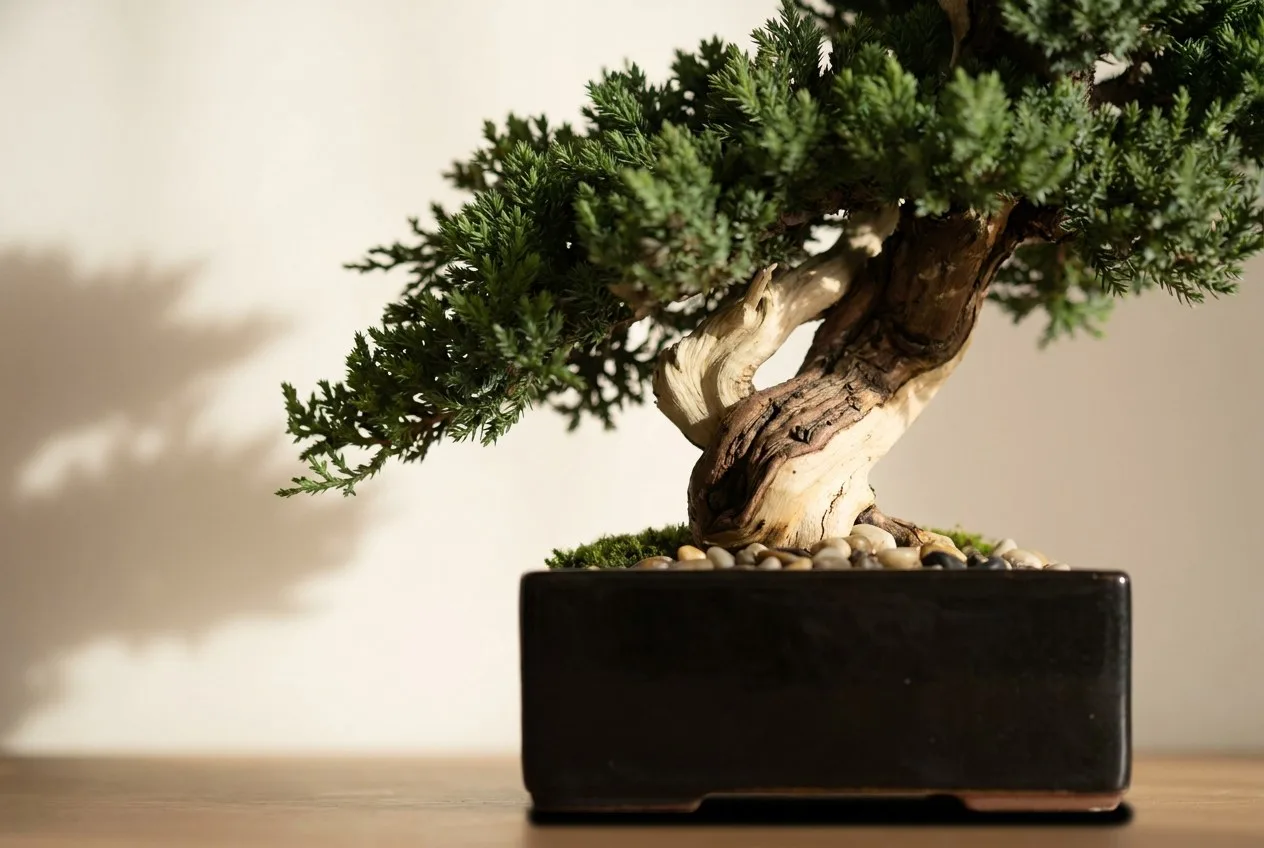
The trunk is a separate question. Most of the pieces we sell use natural grape wood, which grows into its own twisted shape rather than being carved to one. That is why a preserved bonsai looks older than it is, and why the one that arrives will not match the photograph exactly.
How long it lasts
Juniper lasts seven years or more, boxwood about seven, eucalyptus ten or more. Those figures come from the preservation records for the lines we carry. Lifespan depends on the plant rather than the process, and nobody else on this subject publishes the numbers by plant.
Anything with flowers worked into it runs shorter, about three years, because floral elements take more handling.
Those figures describe an interior position out of direct sun and out of damp, and they are what the material does rather than a warranty.
The bonsai are bought in as finished pieces, so read the juniper figure as the expectation for the same material handled the same way. It is not a measurement taken on these particular pieces.
The bonsai we carry are juniper, so seven years or more is the figure to plan around. It assumes the conditions in the next section: indoors, out of direct sun, out of damp.
A piece kept in an office corridor with no window will outlive one on a west-facing sill by years. The corridor has nothing in it that ages preserved foliage.
The two articles currently ranking for this subject offer “five to ten years or longer” and a five-year warranty, without naming the plant either figure belongs to.
Juniper and eucalyptus behave differently, and a piece with floral elements worked into it has a shorter life than either, about three years, because flowers take more handling.
The two things that age it
Sun. Direct sunlight fades preserved foliage, and it fades unevenly. The side facing the window goes first and goes yellow-grey. There is no reversing it.
This is the same mechanism that works on artificial foliage outdoors, which we have written about at length in the fading guide, and the practical rule is identical. Bright room, yes. Sunbeam, no.
Damp. Glycerin is hygroscopic, meaning it attracts water out of the air. In a genuinely humid room the foliage can go tacky to the touch, and over a long enough period the material breaks down.
Avoid bathrooms, conservatories in summer, and anywhere near a permanently open door in a coastal climate.
It shrugs off everything else. Air conditioning, being moved, a dark corner, a fortnight with nobody in the building: none of that touches it.
What it will not do
The failures all come from expecting it to behave like a plant.
- It will not grow. The size on the label is the size for ever.
- It will not recover. Live foliage that browns can be cut back and will push again. Preserved foliage that has faded or gone brittle is finished.
- It cannot go outside. Not on a patio, not under a pergola. With no roots and no water uptake there is nothing for weather to work with. A covered porch out of the sun is as far out as one should go, and even that is a compromise.
- It will not match the photograph exactly. Natural wood and real foliage vary piece to piece. Ours are photographed individually, but the trunk line, the fall of the moss and the spread of the foliage differ.
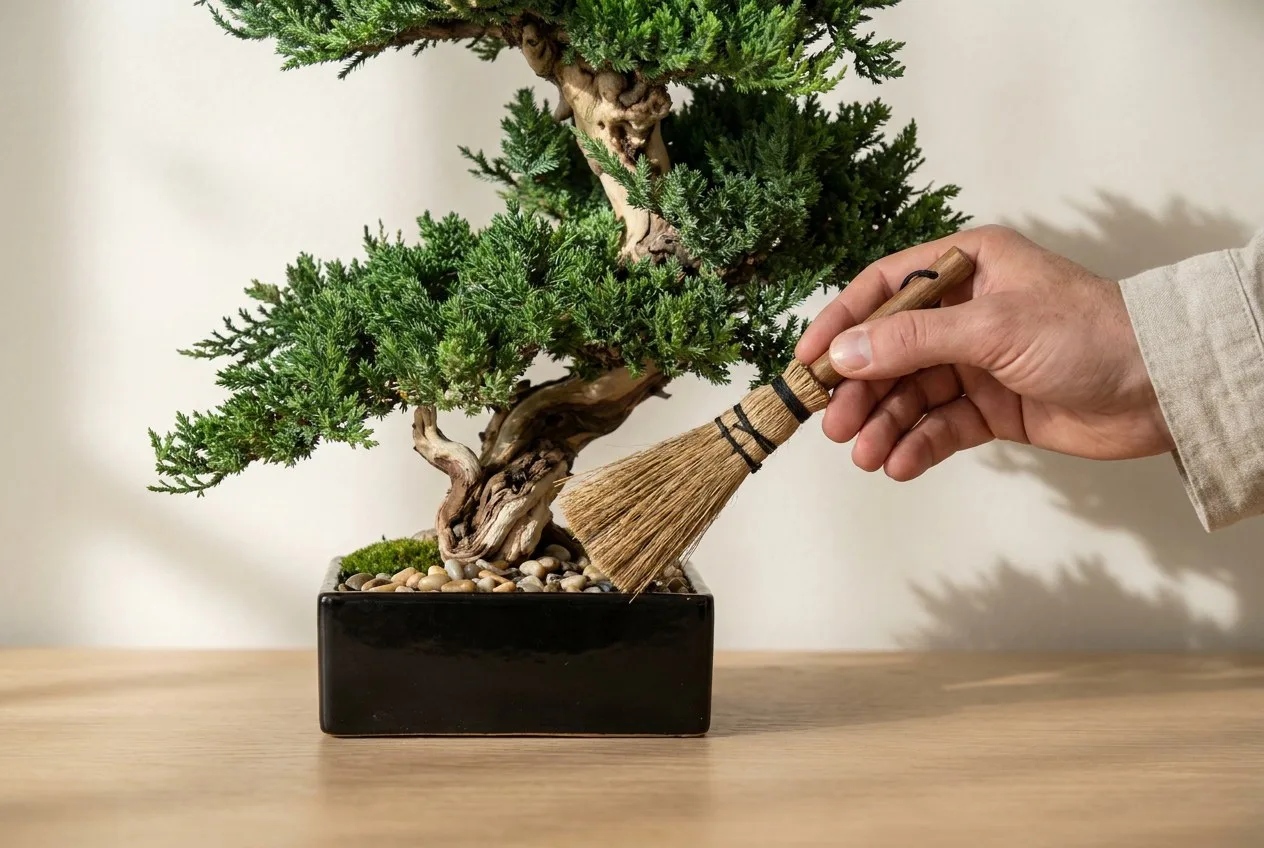
You can dust it. A soft brush, a feather duster, or canned air held a couple of inches back, once in a while. The care page has the same dusting instructions.
How to judge one before you buy
These checks apply whoever you buy from.
Colour variation. Real preserved juniper is never one flat green. Look for lighter tips, greener undersides, sometimes a soft olive undertone. A uniformly bright, single-tone green means heavy dye, which is worth asking about because heavy dye is also what hides poor foliage.
Layering. Shorter leaves should sit tucked inside with longer tips extending out, and some stem structure should be visible under the foliage when you look into it. A perfectly smooth outer surface is a factory-packed piece rather than a hand-layered one.
The trunk. Ask what it is. Natural grape wood has irregular bark, real knots and an asymmetric line. Moulded trunks repeat, and once you have seen two identical ones you cannot unsee it.
The dressing. The surface of the pot should be finished with something, usually preserved moss, gravel or polished stone. A bare pot of foam is a piece that was finished in a hurry.
What one costs
Ours run from $122 to $1,709 across thirteen pieces, which is the honest spread rather than a starting-from number.
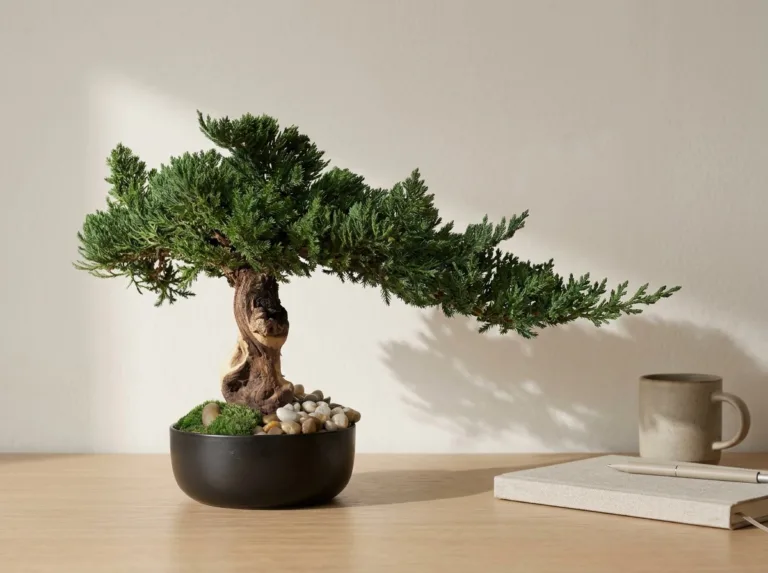
$122. The smallest, on a desk.
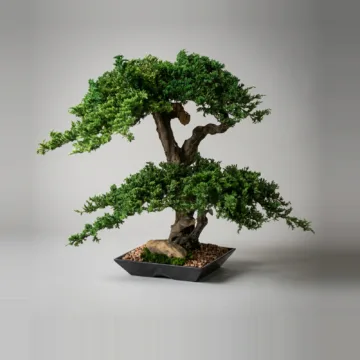
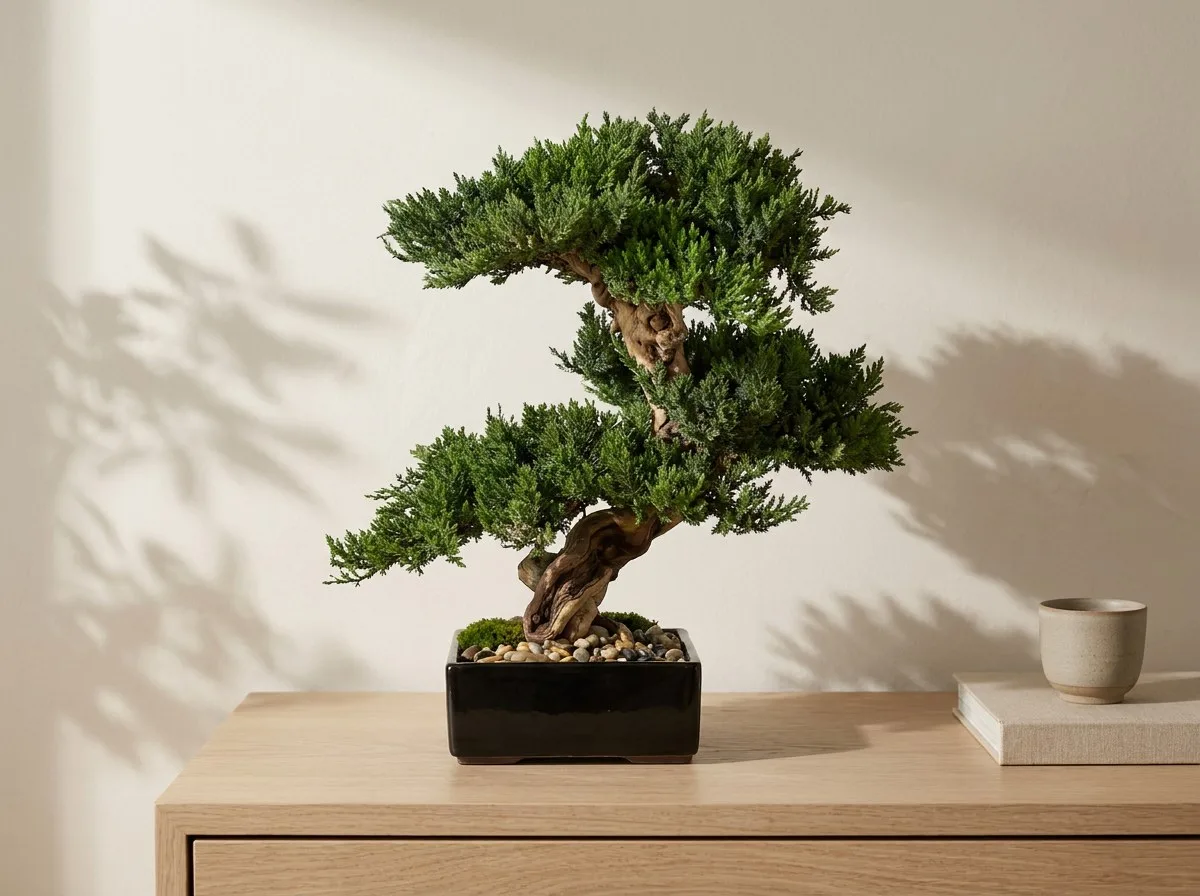
$474. The middle, on a counter.
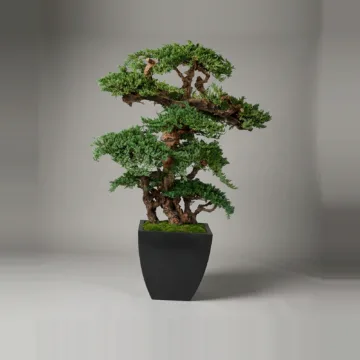
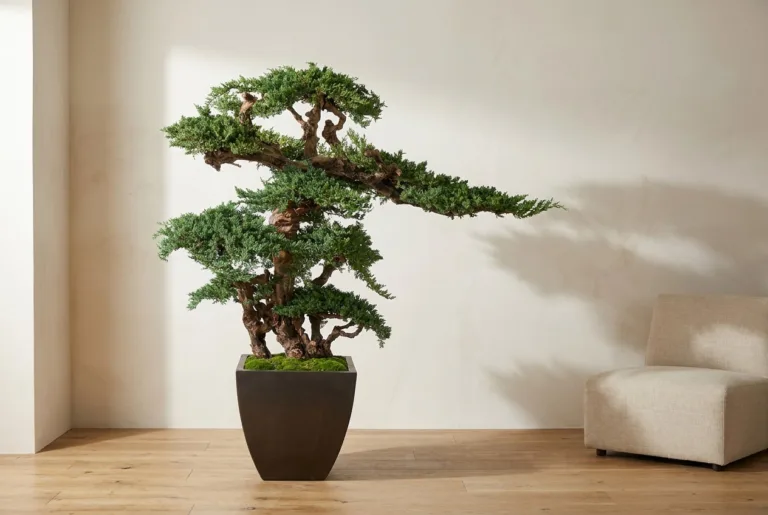
$1,709. Floor scale, quoted with freight.
Below about $250 you are buying a desk piece, ten to sixteen inches, in a ceramic or mango wood pot.
Between $250 and $700 the pieces get taller and the trunk work gets more elaborate. That is where the double and triple mounds sit.
Above $700 you are into floor-standing scale, three to six feet. At that size the piece travels by freight rather than by parcel, so we quote the tree and its delivery together instead of surprising anyone at checkout. How that works is set out separately.
Price is not what separates these from a live bonsai. A live specimen at twenty inches costs what ours costs, then wants watering and feeding for a decade, plus wiring and repotting to hold its shape. It dies if you go away for three weeks in July.
The preserved bonsai we carry are all in one place, smallest first.
Questions we get asked
Is a preserved bonsai real or artificial?
Real, and then treated. The foliage grew on a juniper and was cut; the trunk is natural wood. It is no longer alive, so it needs no water and has no growing season.
Does it fade?
Yes, in direct sun, and the fading is permanent. Out of direct sun it holds its colour for the life of the piece, which on juniper is seven years or more.
Does it come with the pot?
Yes. Every piece is sold planted and dressed, and the container is part of what is photographed. The pot is not swapped after you order.
Will mine look exactly like the photograph?
Close, and not identical. Most stand on natural grape wood, which grows into its own shape rather than being carved to one, so the trunk line and the fall of the foliage differ piece to piece.