The commonest mistake is buying a ball too small for the position. You cannot judge a ball’s diameter from a photograph.
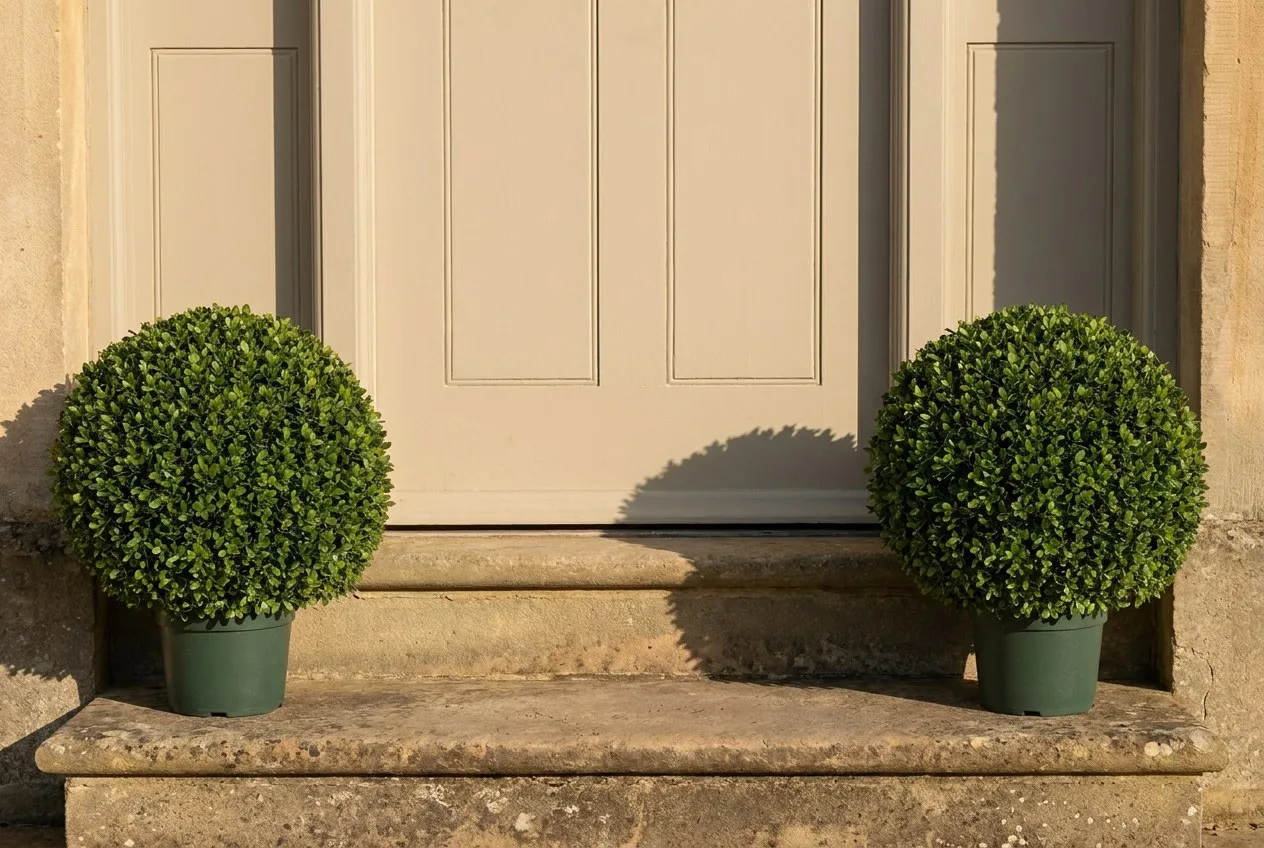
A pair either side of a door, which is the position most of these are bought for.
Why people undersize the diameter
Ours run from 10 inches to 36, and most people buy at the bottom of that range for a position that wanted the top.
Two reasons it happens. A ball looks bigger in a photograph than it does in a doorway, because the photograph has no doorway in it. And an object outdoors has nothing around it to give scale, so the same piece that looked substantial indoors looks modest on a path.
So hold up something you already own of that diameter. A 12-inch ball is about the size of a football. A 24-inch one is a beach ball.
The total height, including the container, decides how the piece looks beside your door. Check that separately from the ball’s diameter.
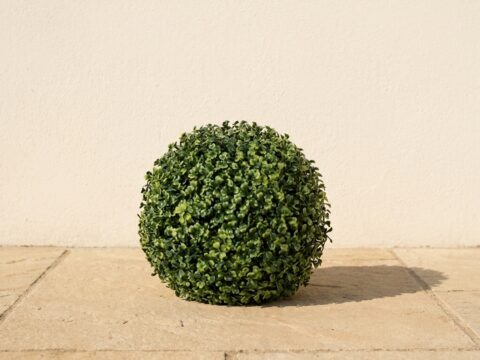
$98. 10 in, fire-retardant on request.
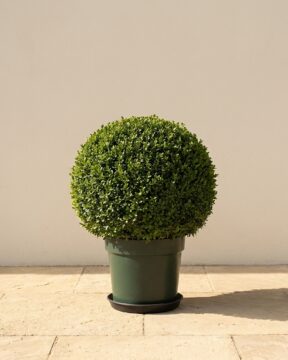
Quoted. Potted, 24 to 26 in overall: the doorway size.
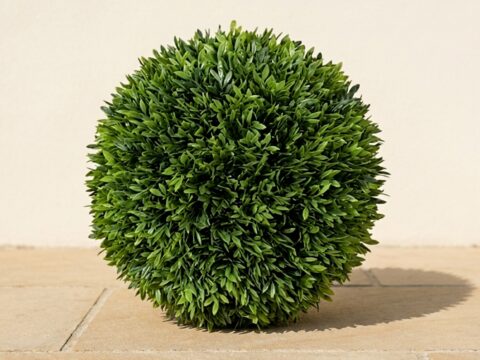
Quoted. Podocarpus rather than boxwood, for a different leaf.
Buying a pair
For a pair either side of a door, order two of the same item and they will match. Match means the same diameter, the same foliage and the same container. Artificial pieces do not vary the way living plants do, which is the one clear advantage here.
Size the pair against the door rather than the step. On a standard door of about 80 inches, a piece whose total height including its container lands between roughly 20 and 30 inches sits comfortably. On most stemmed pieces that means a ball of 12 to 18 inches.
A 24-inch ball is a bigger statement again. It wants a wide entrance, or a pair of generous piers to sit against.
The stem fails before the ball does
A ball on a stem is two objects, and the stem is the one that goes. The head is a lever, so all its weight and all its wind load arrive at the point where the stem meets the pot.
So ask what the stem is on a taller piece. A steel core takes handling and weather. A hollow plastic one eventually does not.
A plain ball with no stem sidesteps the problem entirely, which is worth remembering for an exposed position.
Mounting and wind
In a container on the ground: weight the base with sand or gravel rather than shipping filler, and pot it properly instead of leaving the nursery pot inside a decorative one. Potting one properly covers the method.
On a wall or pillar top: bolt it to the cap. A ball on a pier cap is the single most common thing we hear about coming down, and its own weight will not hold it.
Indoors: nothing needed. Sunlight is what ages artificial foliage and an interior has very little of it, so the cheaper grades are perfectly sensible here.
UV: ask which kind of protection it has
Protection built through the material fades slowly and evenly. A surface coating holds until it wears, and then goes patchy. Ask which of the two a piece uses rather than accepting the phrase.
The hour counts, and what the claims actually mean, are in UV-resistant versus UV-proof, which was written for this category. For the leaf itself, the shades of green and the density, read how to tell good artificial from bad.
A fire-retardant treatment can be special-ordered on some of these balls where a venue requires it. It is applied in production, so ask which pieces can carry it before you order rather than after.
The range is on the artificial balls category. For the living version, globe, ball or standard covers sizing a real one.
Questions we get asked
What size artificial ball do I need?
Size it by the total height rather than by the ball alone. Against a standard door of about 80 inches, a total height including the container of roughly 20 to 30 inches sits comfortably, which usually means a ball of 12 to 18 inches.
Do a pair have to be ordered together?
No. Two of the same artificial item will match, which is the one clear advantage of artificial for a flanking pair. Living plants do not do that.
What fails on a stemmed ball?
The stem at the pot line. The head is a lever, so all the wind load arrives there. Ask what is inside the stem, or choose a ball without one for an exposed position.
How do I stop one blowing off a pillar?
Bolt it down. A ball on a pier cap held down by its own weight is the most common piece we hear about coming down.
Can a fire-retardant treatment be added?
On some of these balls, yes, as a special order. It is applied in production, so ask which pieces can carry it before ordering.