
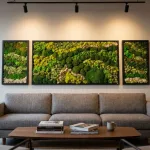




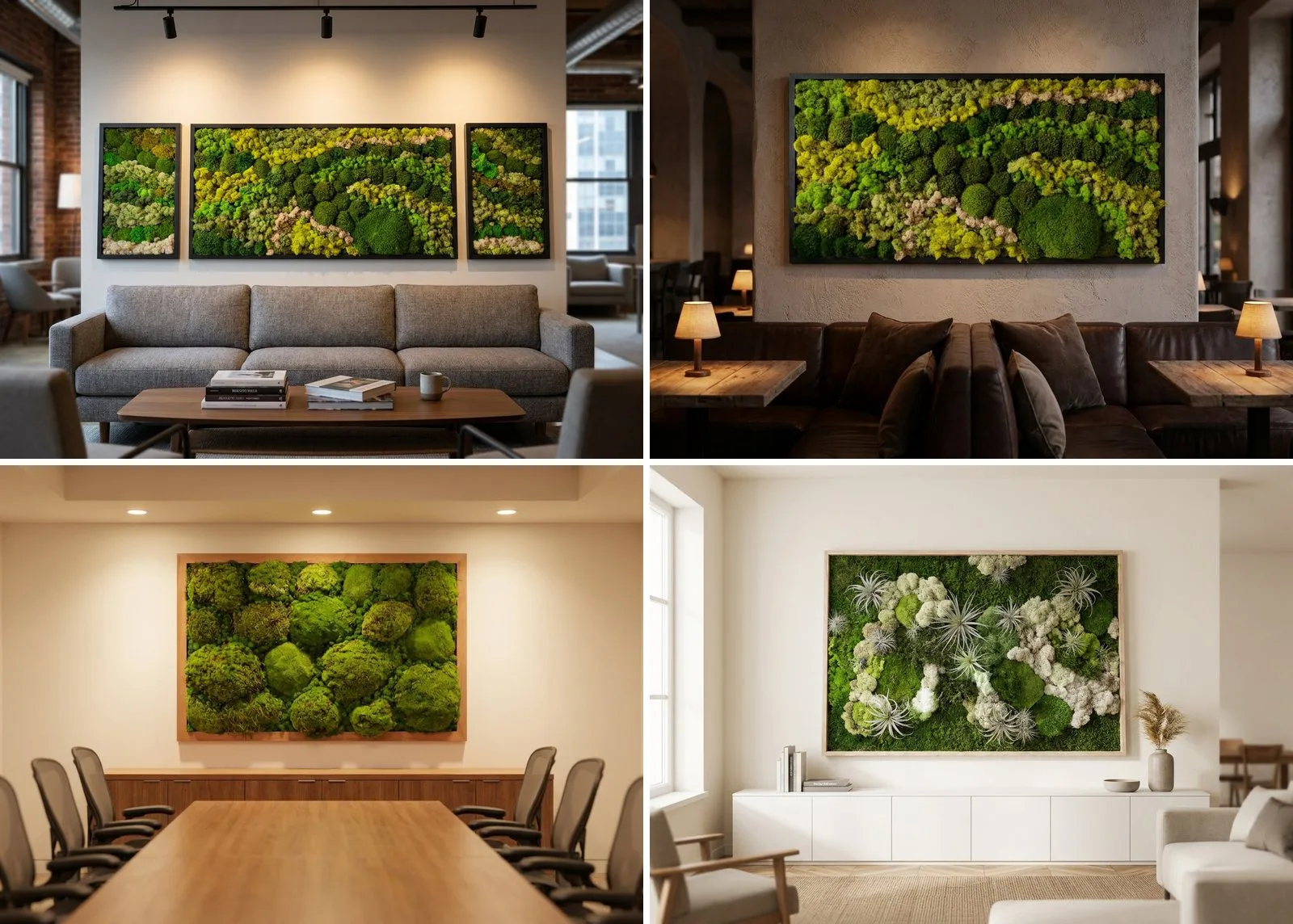
Preserved moss wall art is real moss, treated so it keeps its color and softness without water, set in a frame that hangs like a picture. Ours run from 12 by 24 inch panels up to 24 by 48, singly or in sets, and our team prices each one by quote because they are built to order.
It needs no light, no watering and no maintenance contract. That is why moss panels turn up in offices and restaurants, where a living wall would be a running cost that never ends.
What preserved moss actually is
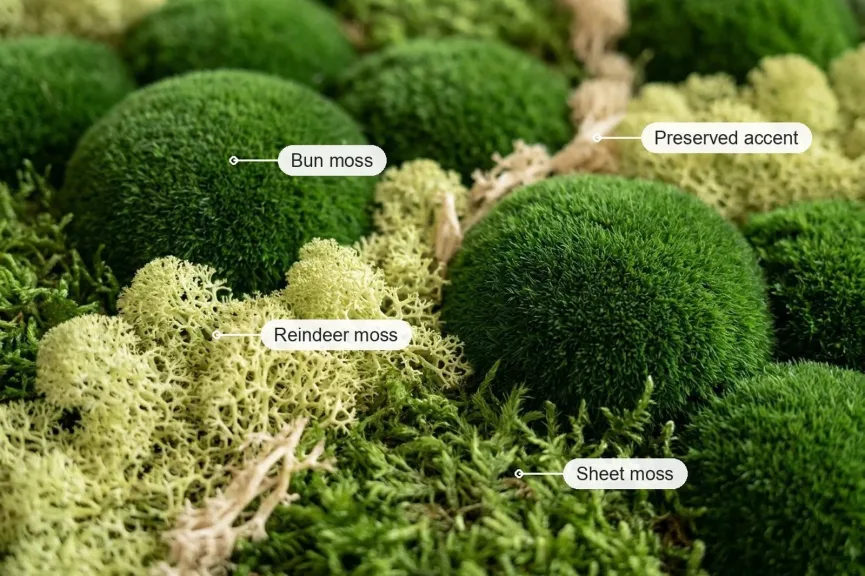
Preserved moss was harvested as real moss, then treated so it keeps its color and softness without water. It is not alive anymore, so it has no light needs, no watering schedule and no roots.
The treatment swaps the water in the plant for a glycerin solution. The glycerin sets inside the moss and keeps it soft, so it does not dry out and crumble when touched. How preserved foliage is made explains the steps.
| Type | What it needs |
|---|---|
| Living wall | Plumbing, grow lights, feeding and a maintenance contract |
| Artificial panel | Dusting, but it looks like plastic up close |
| Preserved moss | Dusting, and it is real moss |
What it costs
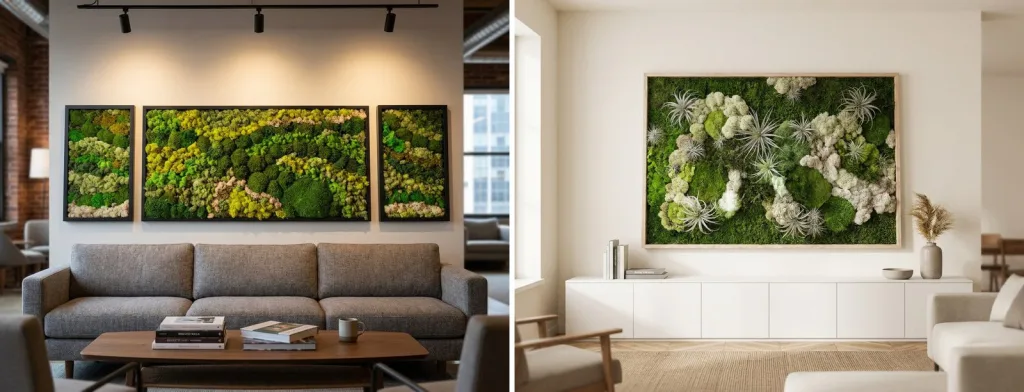
Ours run from framed panels at 12 by 24 inches up to 24 by 48, sold singly and in three-piece sets. Our team quotes each one, because they are built to order and the moss mix changes the price.
A price on a 24 by 48 panel tells you nothing about a 30 by 30. Ask for a price per square foot and quotes become easy to compare. A 12 by 24 panel is two square feet. A 24 by 48 is eight.
Three things move the price: how densely the moss is packed, how many kinds of moss are used, and the frame. Ask any seller which mosses they use, how deep the relief is, and what the backing is. A cheap panel is often cheap because the moss sits thin over a board.
Browse the wood-framed moss panels, the three-piece 12 by 24 set and the shadow box with air plants.
Where it earns its place
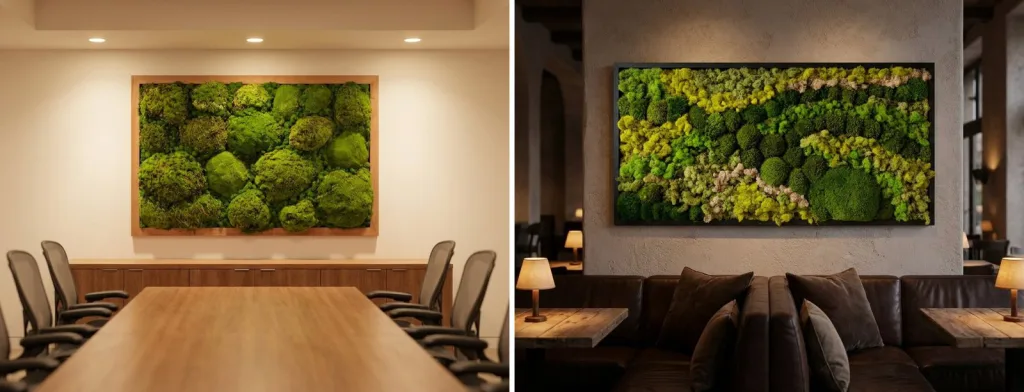
Preserved moss goes where a wall needs green and the building cannot support a living one.
Interior corridors and elevator lobbies. These get no daylight at all. That rules out a living wall without a lighting budget, and it suits preserved moss.
Reception and behind a desk. People see the panel close up. That is where preserved beats artificial by a distance, because the texture is real.
Restaurants and bars. There is no soil and no irrigation, so there is none of the mess or drainage a living wall brings, and nothing to water above a service area.
Meeting rooms. A deep moss panel is a soft, uneven surface, so it takes some of the echo out of a hard room. Treat that as a bonus, not an acoustic treatment.
For larger installations, see commercial moss walls. If you want the moss on its own, see bulk preserved moss.
The two places it cannot go
Direct sunlight. Sun fades preserved moss, unevenly and permanently. A panel on a wall that takes hard afternoon light through glass will show it within a year. A bright room is fine, as long as the sun does not fall on the panel.
Real damp. Glycerin draws water from the air. In a wet room the moss turns tacky and, over time, breaks down. Pool areas, spa wet rooms and unventilated bathrooms are all wrong for it. Ordinary office humidity is fine.
It is fine with air conditioning, rooms with no windows, a month with nobody around and a building that empties over the holidays.
How long it lasts, and what upkeep means
Kept indoors, out of sun and out of damp, a preserved moss panel lasts for years rather than months. There is no published lifespan figure for preserved moss on its own, so be wary of any seller who quotes a precise one without saying where it comes from.
Upkeep is an occasional dusting with a feather duster, or canned air held a few inches away. No watering, no feeding, no trimming and no replanting. So a preserved panel has almost no running cost, where a living wall has one every month.
Buy several panels rather than one continuous surface to keep repairs cheap. Faded or damaged moss does not recover, so you replace the affected panel instead of the whole wall.
Quick answers
Is preserved moss real moss?
Yes. It was harvested, then treated so it keeps its color and softness without water. It is no longer alive, so it needs no light and no watering.
Does moss wall art need any light?
None. An interior corridor with no window suits it as well as a bright room. That is what makes it work in buildings a living wall cannot.
How long does preserved moss wall art last?
Years rather than months, indoors and out of direct sun and damp. There is no published figure for moss on its own.
Can it go in a bathroom?
Not a wet one. Glycerin pulls water from the air, so in a damp room the moss turns tacky and breaks down over time.
Do you water preserved moss?
No. Never water or mist it. Dust it now and then instead.
Keep reading: which moss for which job, commercial moss walls and the wall art range.