Choose your bonsai for the room and how often someone is there. Both matter more than your budget. Your options are live, artificial and preserved. Most comparisons run two columns, real and fake, and leave preserved out.
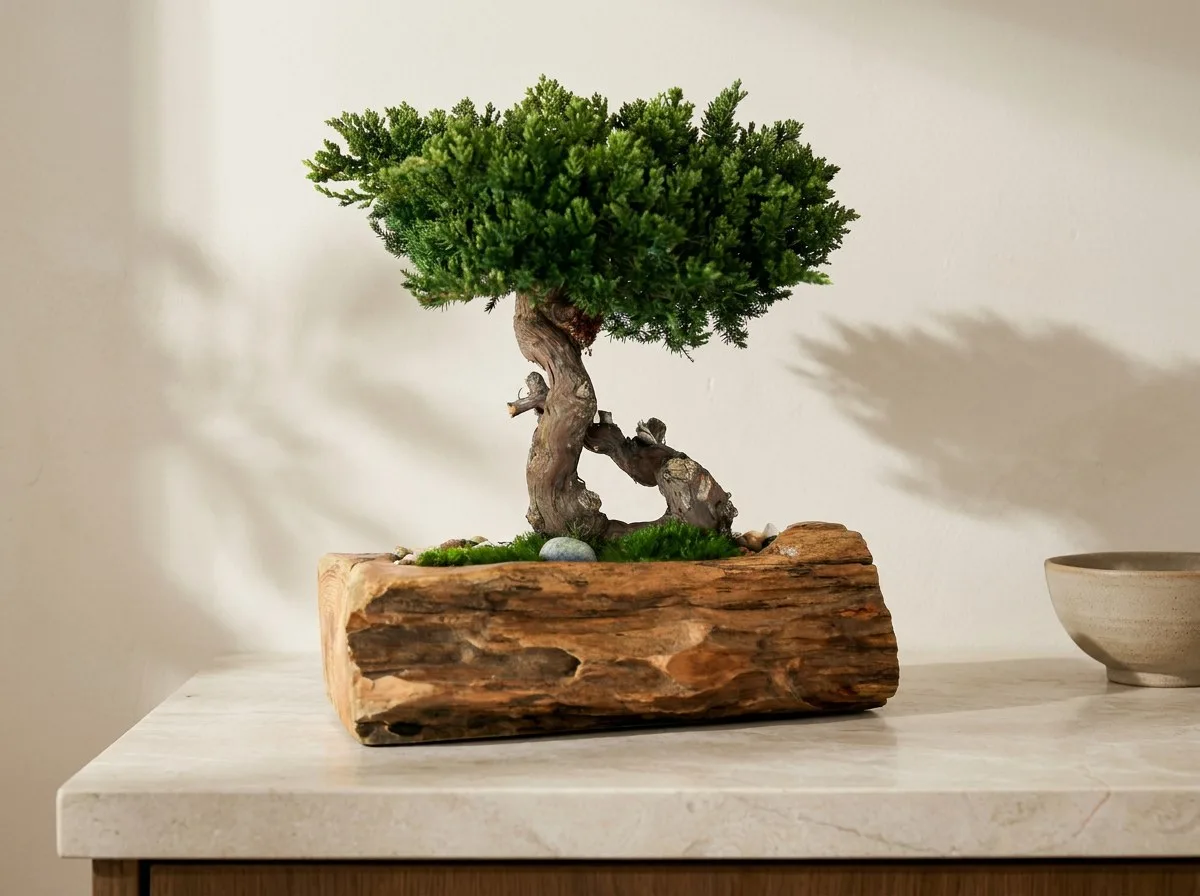
The 20 inch juniper in its teak trough. That one is $226.
A live bonsai asks for daily work
A live bonsai is a horticultural commitment dressed up as an ornament. Most of them die in the gap between what the owner expects and what the plant wants.
Start with the species, because it settles everything else. Juniper, pine, maple: outdoor trees. They need a real winter to go dormant and full sun in the growing season. Keeping one in a living room is the commonest way a beginner kills a first tree.
Ficus, jade, Fukien tea: the tropicals. These are the species that will genuinely live indoors. They need a bright window, they resent draughts, and they still want watering on the plant’s schedule rather than yours.
Before you buy a live bonsai, decide who will look after it. Check the water daily in summer, not weekly, because the tiny volume of soil dries in hours. Feed through the growing season. Prune to keep the silhouette, and wire to set the branch lines. Remove the wire before it bites into the bark.
Repot and prune the roots every two to five years, depending on the species and the pot. A live bonsai in a house with a keen owner is a fine thing and gets better every year. In a reception area, where the person nearest it changes every six months, it is a slow public failure.
Artificial goes where the other two cannot
Artificial bonsai is polyester foliage and moulded plastic over a wire armature. Nothing in it grew and nothing in it degrades from the inside, which is the point of it.
Choose artificial bonsai for high-traffic spots, rooms with humidity swings or places that get cleaned aggressively. It can take full sun through glass if the material is UV-rated. It also takes handling that would ruin preserved foliage. It is the only one of the three with any business near an entrance that opens on to the street.
Artificial foliage looks less convincing up close. Moulded leaves repeat and real ones do not, so it reads well across a room and less well at arm’s length. On a bonsai that matters more than it does on a hedge, because a bonsai is a thing people lean in to look at.
Preserved is for close range, indoors
Preserved bonsai is a real plant, treated so that it holds its state. The plant’s own moisture is replaced with glycerin over about a fortnight, and then the piece is hand trimmed. The longer explanation is here, including how long each plant lasts.
Preserved beats artificial at close range, because the leaves are real leaves and the trunk is real wood with real knots in it. It needs no water, no light, no feeding and no pruning. It has no growing habit to go wrong either, so the shape it arrives in is the shape it keeps.
Keep a preserved bonsai indoors, out of direct sun and damp. Direct sun fades it, permanently. Real damp softens it. Neither is recoverable, and both are covered in the longer piece on how preserving works.
Inside those limits, seven years or more on the juniper pieces. That figure comes from the preservation records for the lines we carry, so treat it as what to expect rather than a guarantee.
The short version
Live needs a bright window and water checked daily in summer. It needs feeding through the season, pruning for shape and wiring for the branch lines. Most of all it needs somebody who wants to do all of it.
Artificial needs nothing, takes sun and knocks, and reads less convincingly at arm’s length.
Preserved needs nothing either, and it reads as real because it is real. It lasts seven years or more on the juniper pieces. It cannot take sun or damp.
For most buyers, having someone who will keep looking after the bonsai matters more than price.
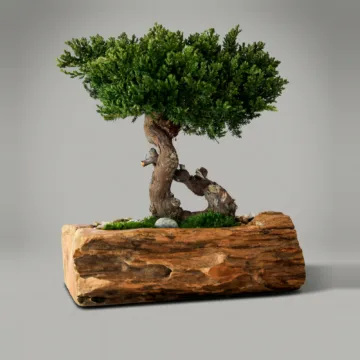
$226. Preserved: real juniper, real carved bowl, no light needed.
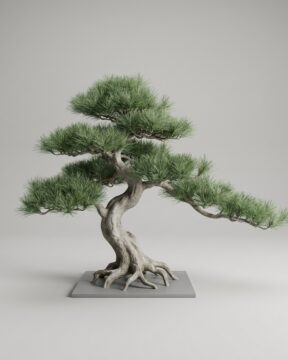
Quoted. Artificial: the one to ask about for a sunny or high-traffic spot.
So which one
A home, with someone who wants a hobby. Live. Buy a tropical species, keep it in the brightest window in the house, and accept that the first year is a learning exercise.
A desk, a console, a shelf in a room people sit in. Preserved. It sits at close range, indoors and out of the weather, and nobody has to remember anything.
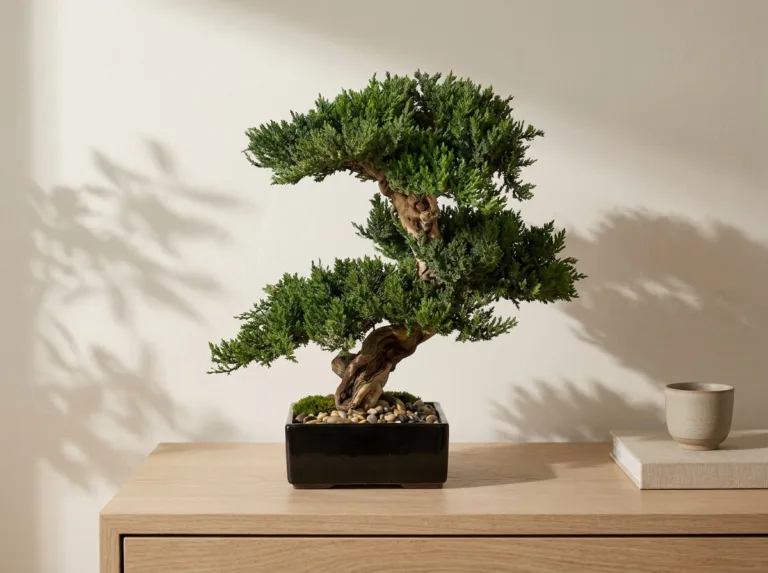
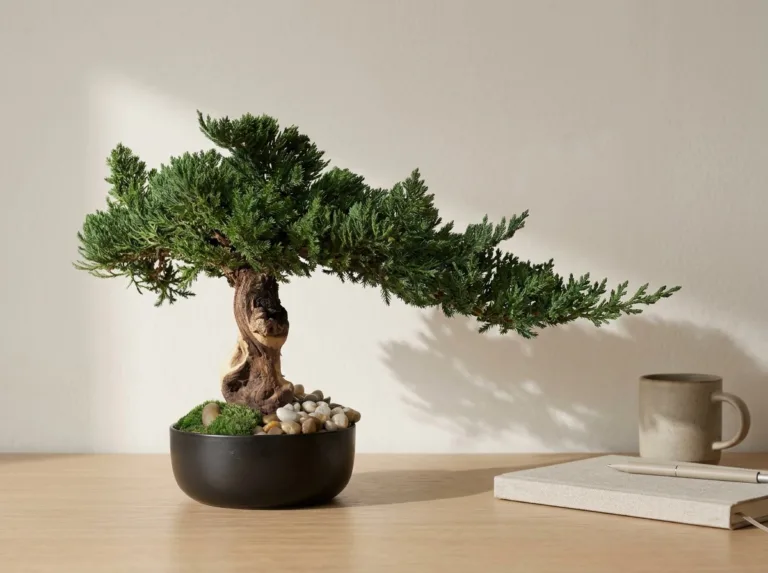
The 10 to 12 inch traditional at $122 is the smallest that still reads as a whole tree. Spend $226 and you get the 20 inch juniper in a carved teak bowl, which is what people buy when the surface can take it.
Reception, a meeting room, a corridor, a hotel landing. Preserved, unless the spot is in a sunbeam. Nobody in those rooms owns the watering.
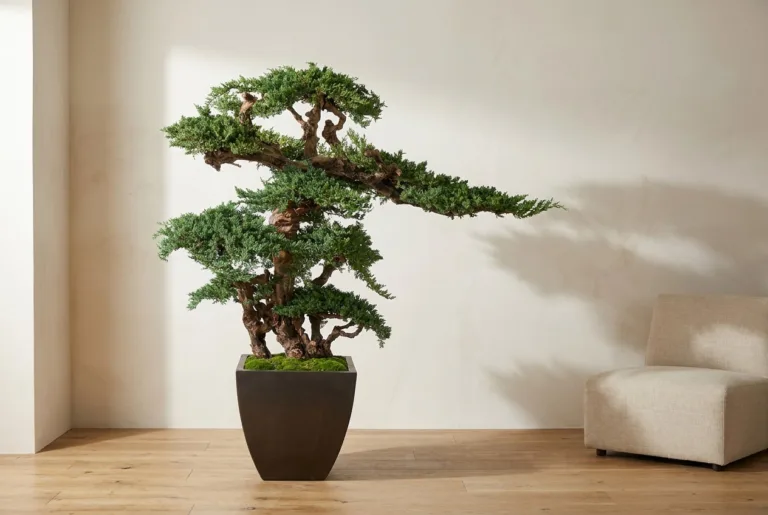
A sunny window, a porch, an atrium with a glass roof, anywhere children or dogs get at it. Artificial, and UV-rated. We carry two, a cedar at roughly two feet and a larger piece at about five, both quoted rather than priced in the cart.
Spend five minutes on the guide to what UV-rated actually means before you buy. The term is used loosely and the difference is measured in years.
Outdoors, in weather. A live bonsai of an outdoor species belongs here and will be happier than it ever was indoors. If that is the plan, buy from a specialist nursery.
A preserved piece does not belong outdoors, because it has no water uptake and will not recover. And a bonsai is pot-scale, so for a position that has to read from across a garden, look at preserved topiary and the artificial ranges instead.
The mistake worth naming
People buy live for the authenticity and then put it where nothing can live. The tree dies in about four months. Underwatering does it in weeks one to six, and then a guilty owner overwaters it in weeks seven to twelve.
If the room is wrong for a plant, stop trying to put a plant in it.
We carry preserved and artificial bonsai , ten inches to six feet. We do not sell live bonsai and we do not pretend to. For a live tree, a specialist nursery will serve you far better than we would.
Questions we get asked
Preserved or artificial: which one looks more real up close?
Preserved, because the leaves are real leaves and the trunk is real wood. Artificial reads well across a room and less well at arm’s length, which matters more on a bonsai than on a hedge because a bonsai is a thing people lean in to look at. A live tree beats both, if somebody keeps it alive.
Can a preserved bonsai go in a sunny window?
No. Sun fades preserved foliage, and the fading is uneven and permanent. For that position, buy a UV-rated artificial piece instead.
Do you sell live bonsai?
No, and we will not pretend otherwise. For a live tree a specialist bonsai nursery will serve you far better than we would.