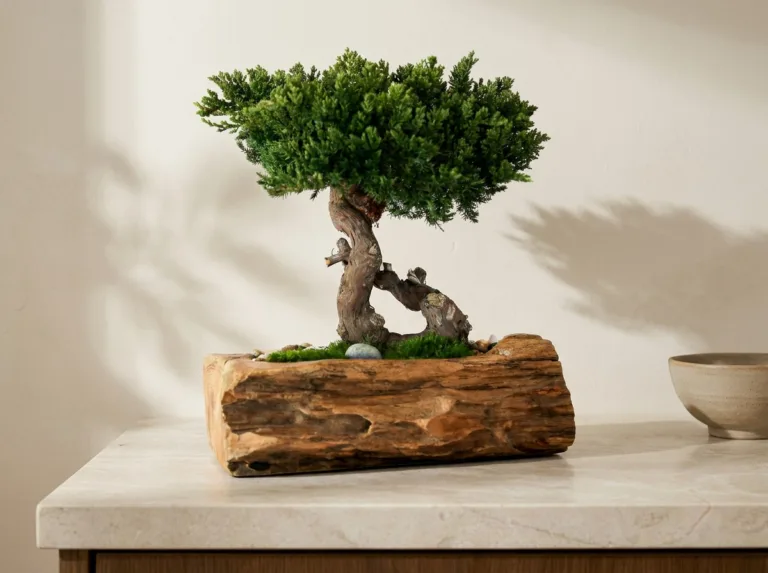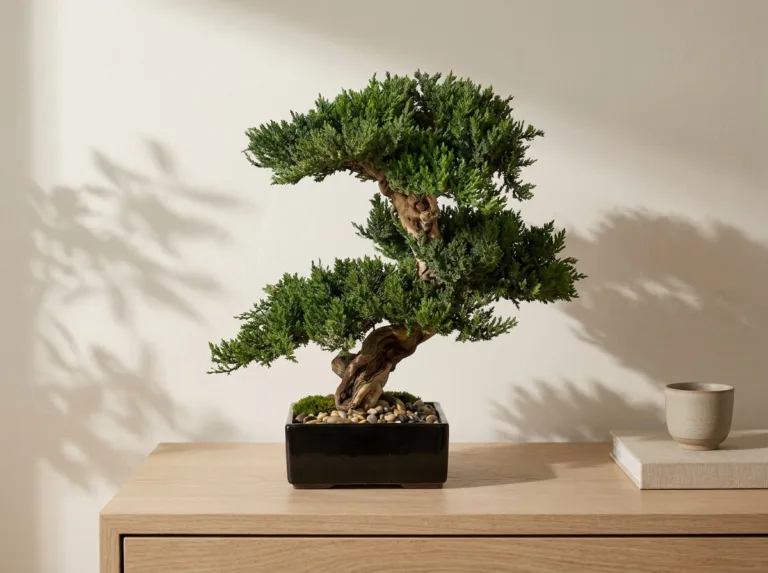
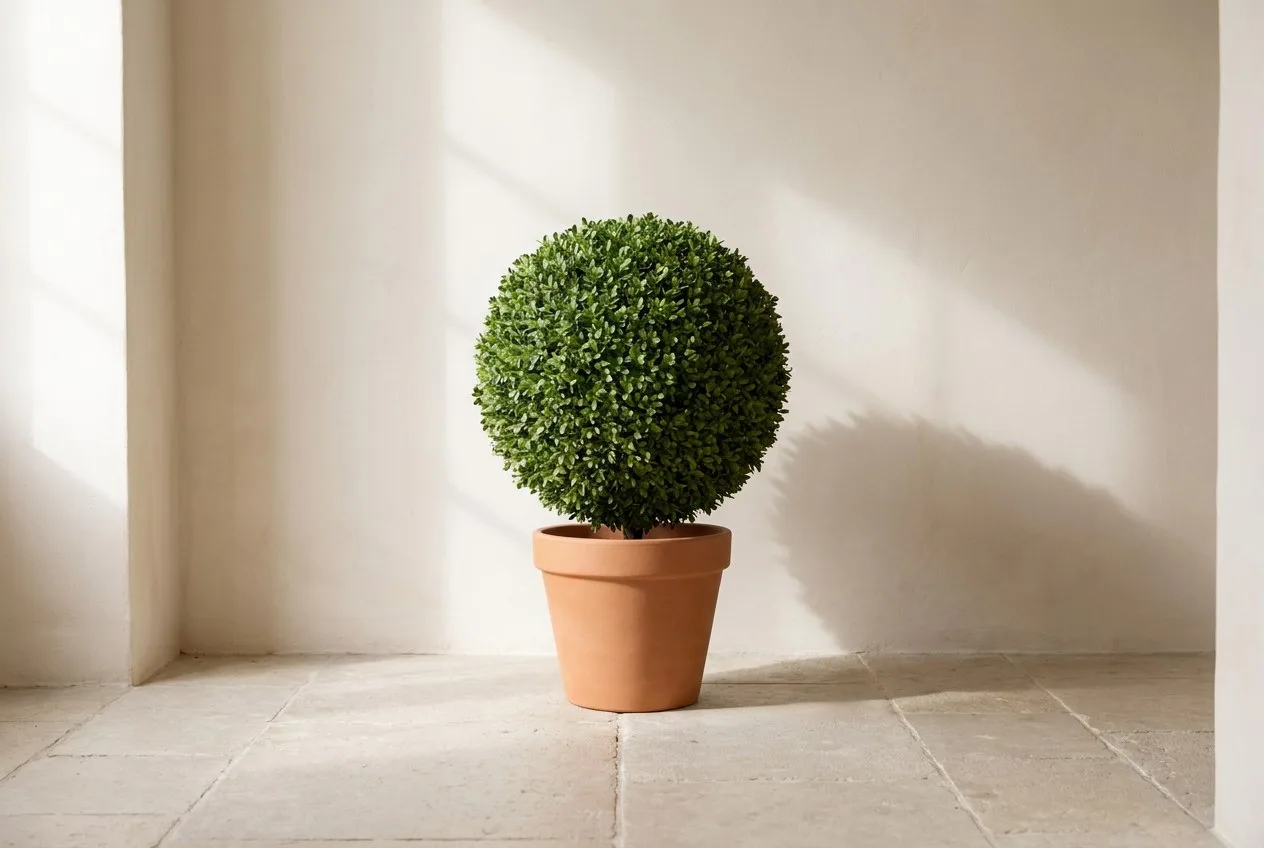
Before you order, settle the fire specification, the lead time, the mounting and who cleans it. Buying topiary for a building is a different job from buying it for a house, and this is the list we get asked. Where we cannot stand behind an answer, we say so.
Preserved topiary suits interiors with no daylight.
1. Fire rating: what we can and cannot claim
Preserved foliage carries no flame-spread rating from us and we will not claim one. It is real plant material treated with glycerin, and treating it further is not something we offer.
Some artificial lines can be supplied with a fire-retardant treatment on special order. It is applied in production, not afterwards, so it has to be raised with the order rather than at delivery. A treatment is not a tested rating, and we will not describe it as one.
If your scheme requires rated interior finishes, tell us at enquiry. We will tell you which pieces can meet it and which cannot.
2. Lead time: ask for a current one
Ask us for a current lead time for anything made to a drawing, because the production queue changes. Anything in stock ships on the normal despatch cycle.
Two things predictably slow it down. For December seasonal work, the queue is generally full by late autumn. Large pieces need a route survey and a footing design before anything is fabricated.
3. Quantities and trade terms
Multiples are quoted together rather than bought at list. For a fit-out that is usually the cheaper route, because freight consolidates.
Tell us the rooms, the surfaces and the quantity in one go and you get a single number. Trade and wholesale volumes go through the wholesale route. Repeat supply is quoted rather than listed.
4. Mounting and public contact
Three questions decide this: can somebody knock it, can somebody climb it, and can somebody take it away.
Interior pieces in circulation space want a weighted or fixed base. Anything over about six feet outdoors anchors to a footing. Public sites use anti-vandal fasteners to stop people carrying pieces off.
None of these are built to be climbed, and none should be specified as though they were. The larger sculpture has internal steel tubing for strength, so it does not rely on its shell.
5. Who maintains it, and what that costs
Preserved and artificial: dusting, occasionally. No watering, no feeding, no replacement planting and no maintenance contract, which is why both turn up in buildings where nobody owns the plants. Budget the cleaning into the normal housekeeping round rather than as a line of its own.
Live: a real horticultural commitment. In a commercial setting that means a maintenance contract or a piece that dies on a schedule. We will say so rather than sell you a plant for a corridor.
Mossed: watering, and a decision within about six months to either plant into it or renew the moss.
6. Environment, and the two positions to rule out
Direct sun fades preserved foliage unevenly and permanently. Atriums, glass links and west-facing walls want UV-rated artificial instead.
Real damp softens preserved material, which rules out pool surrounds and wet rooms. Ordinary conditioned office humidity is fine.
Outside those two, a windowless interior at ordinary office humidity is straightforward for both preserved and artificial. Preserved topiary for interiors sets out the material in detail.

Quoted. Preserved balls, 19 to 35 in.

$799. A 50 in double for a floor position.
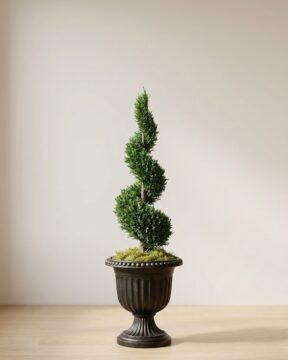
Quoted. An 84 in spiral, quoted with freight.
7. Delivery and access
Larger pieces travel by freight, quoted with the piece rather than added later. Kerbside means kerbside, so somebody has to be expecting it with the right equipment.
Survey the route before the order, not after. Measure the gate and door widths, the turn at the top of a stair, the internal dimension of the lift, and the floor the delivery vehicle has to cross. What freight delivery involves covers the process.
What to send us
Send four things and we come back with a set, a price and a lead time. First, a list of positions with the surface each piece stands on. Then the height range you have in mind, whether any position takes direct sun, and whether the scheme has a fire specification.
For sector work, start with hotels and resorts, events and brand activations and commercial sculpture.
Questions we get asked
Is your topiary fire rated?
Preserved foliage carries no flame-spread rating and we will not claim one. Some artificial lines can be supplied with a fire-retardant treatment on special order, applied in production rather than afterwards, so it must be raised with the order. That treatment is not a rating, and we do not present it as one.
What is the lead time?
Anything in stock ships on the normal despatch cycle. Anything made to a drawing runs to the production queue as it stands on the day you ask, so ask us for a current lead time. Seasonal work is generally full by late autumn.
Do you price by quantity?
Multiples are quoted together rather than bought at list, which is usually cheaper for a fit-out because freight consolidates. Trade volumes go through the wholesale route.
Who maintains it?
Preserved and artificial need dusting and nothing else, which is why they suit buildings where nobody owns the plants. Live planting in a commercial interior needs a maintenance contract, and we will say so rather than sell you a plant for a corridor.
What do you need from me to quote?
A list of positions with the surface each piece stands on, the height range, whether any position takes direct sun, and whether the scheme has a fire specification.