


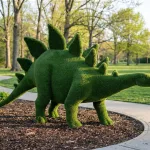

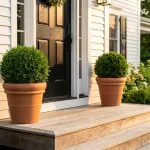


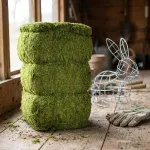
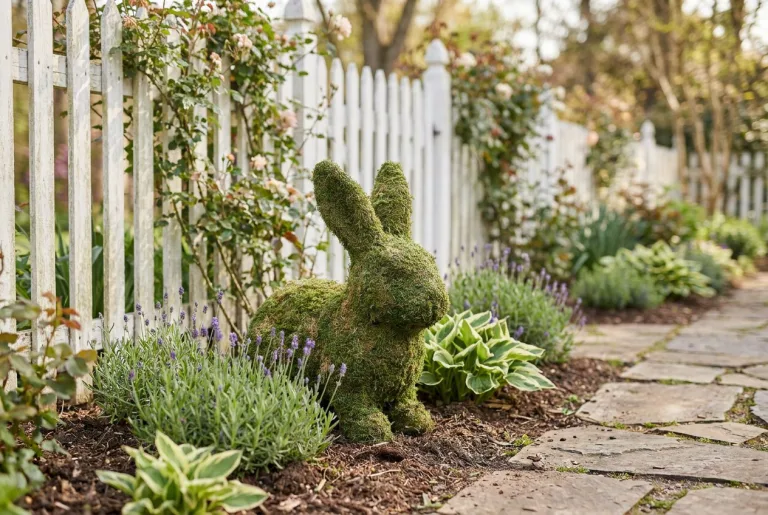
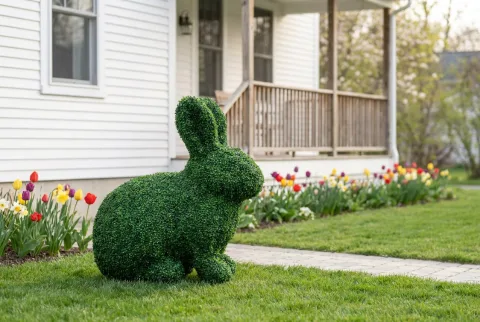


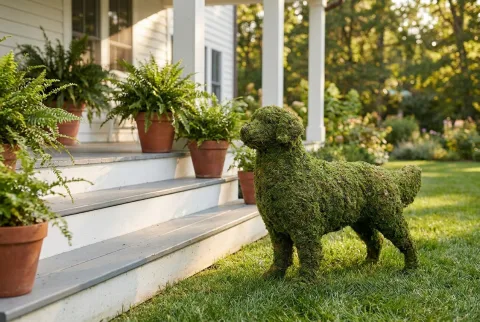
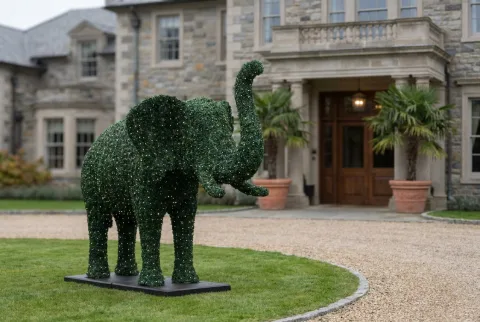
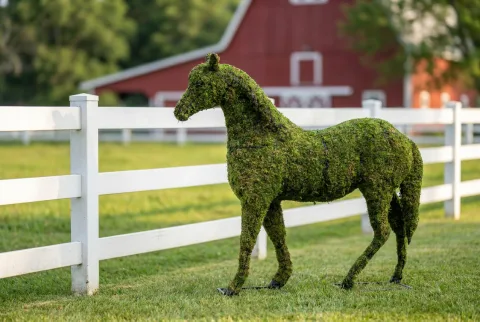








The hard part of a planted topiary is getting plants to root inside the frame and stay there. The frame itself, wire or mossed, is the easy part. This page covers how we do it. To build the piece first, read how to make topiary animals from plants.
What size pot should go inside the frame?
Match the pot to the form as closely as you can, in size and in shape: a round pot inside a round body, a longer container inside a longer one. If one pot will not follow the shape, set several smaller pots in different areas inside the frame. They fill the form faster than one pot fighting the outline.
Pick a small pot for less pruning, or a larger one for plants that last longer. Small pots limit how big the plants grow, so you will replace them sooner.
Plants rarely sit where you want them the first time. Wedge packing peanuts or floral foam behind and under the root ball to force them into place. It feels crude, but it works: the foam holds the plant against the inside of the frame until the roots take over.
Which plants fill a frame fastest?
Use plants that thicken when you trim them. Many plants respond this way, and it is the most useful habit a topiary plant can have, because every cut that shapes the piece also fills it. A plant that resents pruning will hold its outline but never fill.
Then pick just a few plants with matching water and light needs. The most common failure we see is a mixed planting where one species wants shade and another wants full sun. Both decline within a season.
Most plants are flexible about light once they are established, rooted and visibly growing. A spot with morning sun suits nearly all of them. Research each species before it goes in the frame, not after.
For trailing growth, low herbs adapt well to the space they get. Creeping thyme spreads low and fills awkward areas that do not want height.
For quick cover through the top of a form, cheap succulents work well. Let the cut ends callus over, set them into dry soil inside the form, and expect roots in about a month.
Two plants worth knowing for tails
If your animal form has a tail, these two plants solve it in opposite directions.
| Plant | Habit | Zone & light | Use |
|---|---|---|---|
| Sedum morganianum Burro’s tail |
Lime-green succulent; small leaves on a cascading stem | Zone 10, morning sun | Hanging tail. Survives some neglect, which matters on a piece nobody remembers to water |
| Sansevieria trifasciata Snake plant |
Upright, low-care succulent; green with black markings, some types edged yellow | Zone 10b–11, low light | Upright tail, and the better choice in a dim room |
How do you plant into a mossed frame?
Cut or poke a hole with scissors or a screwdriver and plant through the top of the mossed frame to fill bare spots. Work when the moss is damp, not soaking. Soggy moss kills almost any plant, and a frame that never dries out is the fastest way to lose a whole piece.
Soak the moss in compost tea or another weak fertilizer first. It gives cuttings and young plants a start and noticeably shortens the time they take to root.
Keep hedge clippers, scissors, electric hand shears and pruning shears within reach. Most of the work is scissors.
How should a planted topiary be fed?
Water first, then feed. Liquid fertilizer on dry soil burns the roots.
Feed succulents once a year, in spring, with a weak solution of 10-52-10. It is high in phosphorus, which drives root growth rather than top growth.
Feed traditional plants far more often: weekly or every other week through the growing season.
We start everything on 10-52-10 because a topiary depends on its roots, and phosphorus builds them. Once the roots clearly support growth, switch to a balanced feed such as 20-20-20 for healthy foliage.
Check what each species in the frame needs. A mixed planting may need a compromise.
Compost tea is a gentler option at any stage. We use it on mossed pieces, where a strong solution would be too much.
What happens after it fills in?
Trim to shape as it grows. On the right plants, that trimming is what thickens the piece. After that it is ordinary topiary care (water, light, feeding, pests and placement), and our care instructions cover all of it. To choose species from scratch, best plants for topiary planting goes deeper.
If a piece is struggling and you cannot tell why, call us at 866-306-1020 and describe what you see. We would rather talk it through than have you replace a plant that could be saved.