
The nine artificial topiary shapes that work hardest
Nine shapes cover most of what people ask us for. Balls, cones, spirals, pom poms, hedges, animals and the rest. Which one suits you has less to do with taste than with where it will stand: a shape that holds a hallway can look lost on a forecourt.
Here are the nine, and what each is good at.
Three questions before you pick a shape
Shape is the last of these decisions, not the first.
Live, artificial or preserved. A live topiary grows, and it needs water, light and clipping to hold its shape. An artificial one holds its own. Preserved foliage is real greenery treated to stay soft, and it belongs indoors. This page is about the artificial ones.
Indoors or outdoors. Anything standing outside wants UV-rated foliage. Without it the colour goes, and it goes unevenly, which is covered in do artificial topiaries fade.
The height you actually have. Measure it first. A spiral that looks right under a twelve-foot ceiling is a different object in a room with eight.
1. Ball Topiary
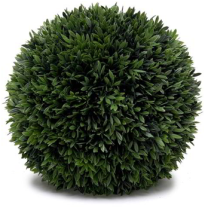
The ball is the shape everything else gets measured against. Compact, quiet, hard to get wrong. Most artificial balls are made to read as boxwood; you will also find ivy and cedar. Because a ball takes up no more floor than its own diameter, it goes where nothing with a spread would fit: a console table, a narrow hall, a small flat. Start here if you are not sure. See the artificial balls.
2. Double Ball Topiary
Two balls on one stem. Sometimes three. It buys height without width, which is why it works in a corner or either side of a door. A triple goes taller again, usually with the largest ball at the bottom and the smallest on top. Storefronts ask for this one more than any other shape in the range.
3. Spiral Topiary
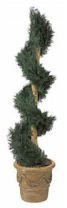
A spiral is a cone with a cut turned through it, so it reads as movement rather than a solid mass. They run tall. That suits a high ceiling, a porch, or a pair either side of a drive. There is a double spiral too, cut twice round, which is the same idea said louder. See the artificial spirals.
4. Faux Tree Topiaries
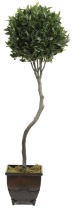
Some of these are simply trees. Cedar, olive, cypress, with the trunk and crown a real one would have and none of the watering. They do less work in a room than a spiral does. Where a clipped shape announces itself, a tree reads as something that was always there. How they are put together is in what an artificial topiary form actually is.
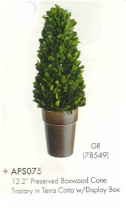
5. Cone Topiary
Wide base, sharp point. The cone is the most formal shape on the list and the easiest to use in pairs: two flanking a door, four down a path. It carries height without taking floor, so it suits the rooms a spiral suits. It is also the shape most often dressed at Christmas, for reasons nobody needs explained.
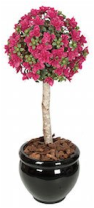
6. Floral Topiary
A ball, but in flower. Usually the ball shape, sometimes looser, always in faux blooms rather than foliage. It is the one shape on this list that brings colour instead of green, so it does the most in a room where everything else is neutral. Use one, not three.
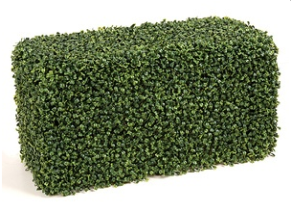
7. Square/Hedge Topiaries
Straight lines, sharp corners, no curve anywhere. A square reads as modern in a way the rounded shapes do not. Lengthen it into a rectangle and you have a hedge, which is what most people actually want it for: blocking a view, marking a boundary, giving a terrace a wall it did not have. Small ones sit well in a window box. See the hedges and shapes.
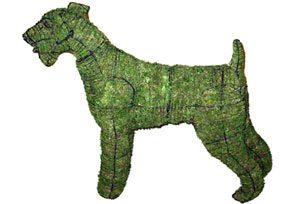
8. Animal Topiary
An animal is not really a shape. It is a commission. Elephants, dogs, lions and birds are the ones asked for most, but the frame decides the form, so it can be almost anything. They are usually large and usually outdoors, though they work inside if the ceiling allows. One is enough for a room. See what gets commissioned.
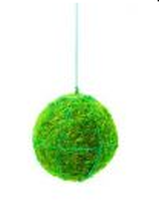
9. Hanging Topiary
The same ball, hung rather than stood. It goes on a hook in the ceiling or a bracket on the wall, and it uses the one part of a room nothing else is competing for. Good in a flat. Good in a stairwell, where there is height and no floor to give up.
What are the benefits of artificial topiaries?
The short answer is that they hold their shape and you do not have to do anything. No watering, no trimming, no working out whether a corner gets enough light. A live topiary needs clipping to stay the shape you bought; an artificial one is already that shape and stays it.
They also travel better. A living plant can arrive stressed from a week in a box, and it takes weeks to settle. An artificial one arrives as it will look.
These are not the plastic plants from a supermarket shelf. Good artificial foliage is built to copy the shape, colour and texture of the real thing, and at a few feet it does. It also lasts. Years with an occasional dusting, rather than a season. That is where the value sits, and why the material grade matters more than anything else on the label.
Artificial Topiary Decorating Tips
Placement does more than shape does. There are more rooms worth of ideas in 8 artificial topiary ideas for home decorating. Two matched pieces either side of a door or a hallway balance each other and read as deliberate. Scatter several small ones of different heights across a table instead, with books and pictures between them, and you get the opposite effect on purpose. Both work. Pick one.
Size it to the room before anything else. A large piece fills a foyer and overwhelms a small sitting room, and the same object does both. If one piece is meant to be the thing people look at, let it be, and keep what is around it quiet.
If you are using several, give them something in common. They do not have to match. But a ball in bright faux flowers beside a muted cedar cone reads as two decisions rather than one.
Want to build a frame yourself instead? That is a different job, and it is covered in make your own wire topiary form.
Featured Image Credit: ractapopulous / Pixabay