
Boxwood topiary care starts with matching the cultivar to your USDA zone — most boxwood is hardy in zones 5–8, and choosing right for your zone matters more than anything you do with a hose or shears afterwards. We grow our own live boxwood, and this guide condenses what we keep on file for the 26 cultivars we track across the contiguous states.
Boxwood earns its place: evergreen, deer-resistant, drought-tolerant once established, happy in sun or shade depending on cultivar, and long-lived enough to be the permanent structure in a landscape.
Which boxwood for your zone
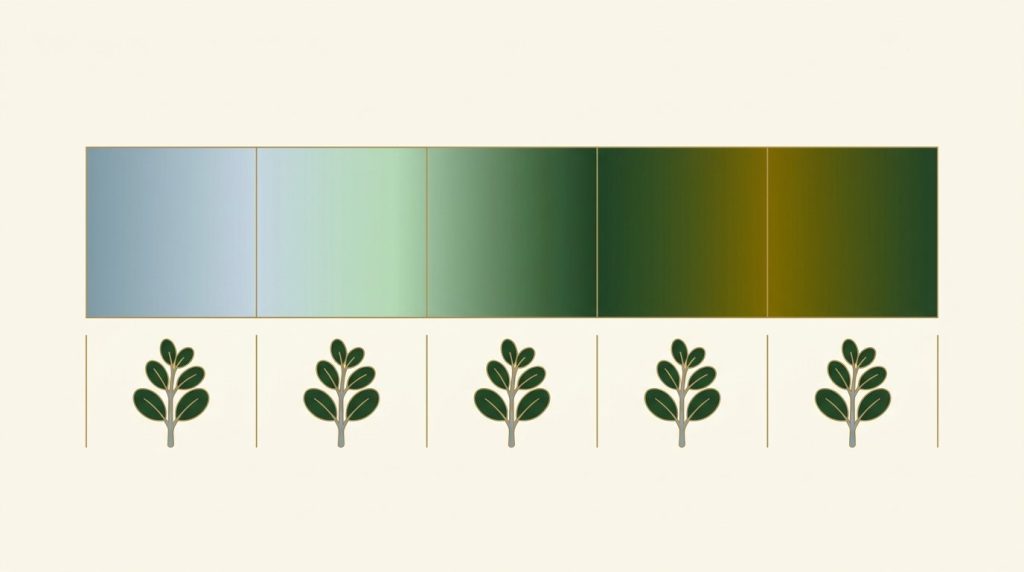
A working shortlist from our cultivar records — zone range, then how it behaves:
| Cultivar | Zones | Behaviour |
|---|---|---|
| ‘Green Velvet’, ‘Green Gem’, ‘Green Mountain’ | 4–8 | The hardy hybrids. Where winters bite, start here. |
| ‘Wintergreen’, ‘Winter Gem’ | 4/5–8 | Fast Korean types; shrug off cold, take hard shearing — hedging and large shapes. |
| ‘Morris Dwarf’, ‘Morris Midget’ | 6–8 | Half an inch to an inch a year; hold shape almost unpruned. Some winter-sun bronzing that spring growth covers. |
| ‘Suffruticosa’ | 6–8 | The classic English edging boxwood of formal parterres. |
| ‘Green Beauty’ | 6–9 | Holds deep green through heat — the pick for warm, humid zones. |
The pieces from this guide, as they arrive
Hover or tap a number to see the piece and its price.
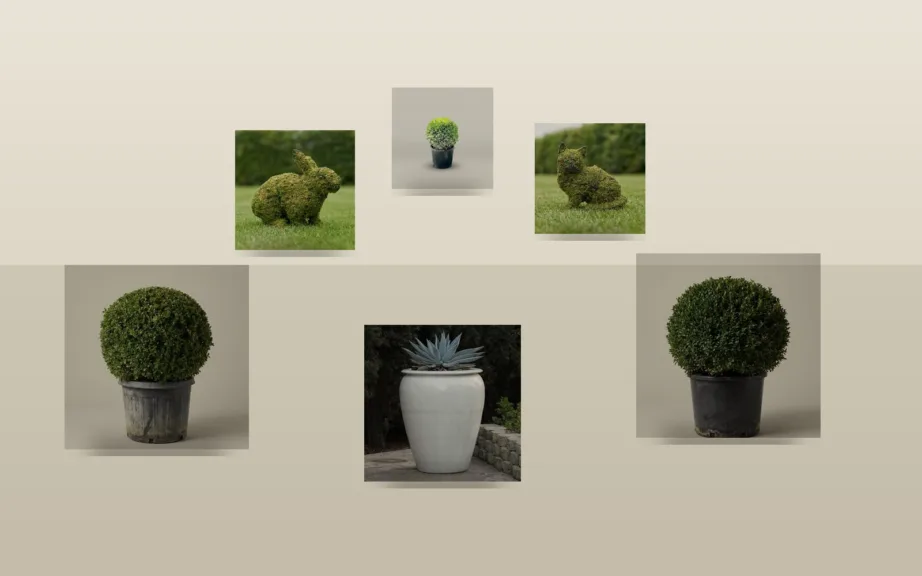
- Live Boxwood Ball Topiary, 24 to 27 inches Tall $325.00
- Live Wintergem Boxwood Ball Topiary, 34-38 in $395.00
- Urn Smooth Finished $1,485.00
- Hopping Rabbit Topiary, Mossed, 13 in $132.48
- Sitting Kitten Topiary, Mossed, 9 in $110.00
- Green Beauty Globe Topiary, 12-15 in $155.00
What your region actually does to a boxwood
Zone numbers describe winter cold and nothing else, which is why two gardens in the same zone can have opposite problems. These are the four situations we are asked about most, and what we would honestly put in each one.
The Gulf Coast and Florida — heat and humidity, not cold
Below about zone 9 the limiting factor stops being frost and becomes humid heat. Boxwood will grow, but it sulks in wet heat, and the still, damp air that sits over the Gulf in summer is the condition fungal problems like best. Give it morning sun and afternoon shade, keep the crown clear so air moves through it, and never water the foliage in the evening.
If a position is full sun on a Florida front, live boxwood is usually the wrong plant for it. The two honest alternatives are a preserved boxwood piece, which holds colour indoors and under cover with no watering at all, or a UV-rated artificial piece for somewhere exposed. Neither is a compromise so much as a different tool: one is for shade and care, the others are for positions nothing living will hold.
Texas and the Southwest — sun, wind and dry heat
Dry heat is a different failure from humid heat. Here boxwood loses water through the leaf faster than hair-like roots can replace it, and the damage shows as scorched edges rather than as disease. Mulch matters more than feeding, afternoon shade matters more than either, and mites arrive in dry spells — check the undersides of leaves before you reach for anything.
For a west-facing Texas frontage in full afternoon sun, a UV-rated artificial boxwood piece is the one that still looks right in August. For a courtyard or a covered entry, live boxwood is fine with shade and a real watering habit.
The Midwest and Northeast — winter, wind and salt
North of about zone 6 the question is not whether boxwood survives but how it looks in March. Three things cause most of the damage: winter wind stripping moisture from foliage the frozen roots cannot replace, southwest winter sun bronzing exposed faces, and road salt. Choose the hardy hybrids, plant out of the prevailing wind, and water deeply into late autumn — a boxwood that goes into winter dry is the one that comes out of it brown.
Containers are the exception worth repeating: a root ball above ground is exposed on every side and behaves roughly a zone colder than the same plant in the ground.
The blight belt — when to stop replanting boxwood
Boxwood blight has moved through much of the Mid-Atlantic and Southeast, and it is soil-persistent. If you have lost boxwood to it once in a bed, replanting boxwood in that bed is usually a slow way to lose another one. Diagnosis and treatment are a subject of their own, covered in boxwood diseases.
The decision this guide can help with is the one after that. Where a bed is finished for live boxwood, a preserved piece under cover or a UV-rated artificial pair in the open gives you the same formal shape with no host for the disease. It is not the romantic answer, but it is the one that stops the cycle.
The do’s, from our growing
Do remove burlap from a firm root ball — it speeds new roots (leave it on a loose ball). Do saturate the root ball at planting and water well until established; hair-like boxwood roots take time to grow beyond the ball. Do feed with a balanced 10-10-10 to 14-14-14 in early March and October — more often, with liquid feed, in containers. Do prune the week of June 1: new growth covers the cut leaves by mid-August. True boxwood enthusiasts pluck rather than shear. Do try cuttings: 4-inch tips in November, set in dense soil or sand somewhere warm.
The don’ts
Don’t buy from a dirty nursery — reject curled, scratched or yellow-tipped leaves and look for succulent white roots. Don’t suffocate the plant: no soil or mulch piled on the trunk, ever — an inch of mulch around it, refreshed every couple of years, is right. Don’t prune in winter, and don’t prune freeze-burned tips until the first freezes have passed.
Quick answers
Do boxwoods do well in pots?
Yes, with two adjustments. A container dries out far faster than open ground, so watering becomes a habit rather than an occasional job, and the exposed root ball behaves about a zone colder in winter. Feed more often and more lightly than you would in a bed. The full version is boxwood in a planter.
Should I water boxwood every day?
No. Daily watering is one of the commonest ways to kill one. Boxwood wants deep, infrequent watering that reaches the whole root ball, then time to drain — constantly wet roots invite rot. Newly planted pieces and containers need more attention than established plants in the ground, but even then the test is the soil, not the calendar.
When should you not trim boxwood?
Not in winter, and not immediately after a freeze. Pruning provokes new growth, and soft new growth going into cold weather is damage waiting to happen. Leave freeze-burned tips alone until the last frosts have passed, then cut back to live wood. Our own shaping is done the week of 1 June, so new growth covers the cut leaves by mid-August.
Can boxwood topiary survive winter?
In its zone, yes — most boxwood is hardy through zones 5 to 8, and the hardy hybrids hold to zone 4. What kills it is rarely the cold number itself: it is winter wind on a dry root ball, and containers left to dry out in late autumn. Water deeply into November and shelter from prevailing wind.
Can boxwood topiary live indoors?
Not for long. Boxwood is an outdoor plant that wants a cold dormancy, and indoor air is too warm, too dry and too dim to sustain it — indoors it thins and drops leaves over a season. For a shape that has to live inside permanently, a preserved piece is the honest answer, because it needs no light or water at all.
Zone extremes
Everything above is written for boxwood in the ground. A root ball in a container above ground is exposed on all sides and behaves roughly a zone colder, so read these bands one step conservatively for anything in a pot. The container version of this guide is boxwood in a planter.
In zones 4–5, choose the hardy hybrids, shelter pieces from winter wind, and water containers into late fall — dry container boxwood is the most winter-vulnerable plant we see. In zones 8–9, afternoon shade and mulch matter more than cold; watch for mites in dry heat. Everywhere, southwest winter sun bronzes some cultivars — it greens up in spring.
Ready to plant? Our live boxwood topiary ships from our own growing, and the full planting-to-pruning care reference covers soil prep, transplanting and irrigation in detail.